Comparing White-Label Tracking And Identification Engines For SaaS Vendors
Compare white-label tracking tools for SaaS vendors—visitor identification, rebranding, CRM integration, scalability and privacy compliance.
Looking for a white-label solution to track and identify website visitors? This article breaks down key features of tools like LeadBoxer and others, helping SaaS vendors choose the right platform for lead generation and visitor insights.
Key Takeaways:
What They Do: White-label tracking engines help SaaS vendors identify website visitors, track behavior, and generate actionable insights without building custom infrastructure.
LeadBoxer Overview: Offers visitor identification, lead scoring, CRM integration, and full rebranding options. It's scalable and privacy-focused.
Alternative Solutions: Some competitors lack accuracy, customization, or privacy compliance, making them less reliable in certain scenarios.
Quick Comparison:
Feature | LeadBoxer | Alternative A | Alternative B |
|---|---|---|---|
Visitor Identification | Accurate, real-time tracking | Relies on external data, less precise | Insufficient data available |
White-Label Options | Full customization, no watermarks | Limited branding, extra costs | Insufficient data available |
CRM Integration | Smooth, automated updates | Requires custom middleware | Insufficient data available |
Privacy Compliance | First-party cookies, GDPR-friendly | Uses third-party cookies | Insufficient data available |
Choosing the right solution depends on your branding needs, integration requirements, and traffic scalability. LeadBoxer stands out for its strong tracking capabilities, flexible integration, and privacy-focused approach.
1. LeadBoxer
Tracking and Identification Capabilities
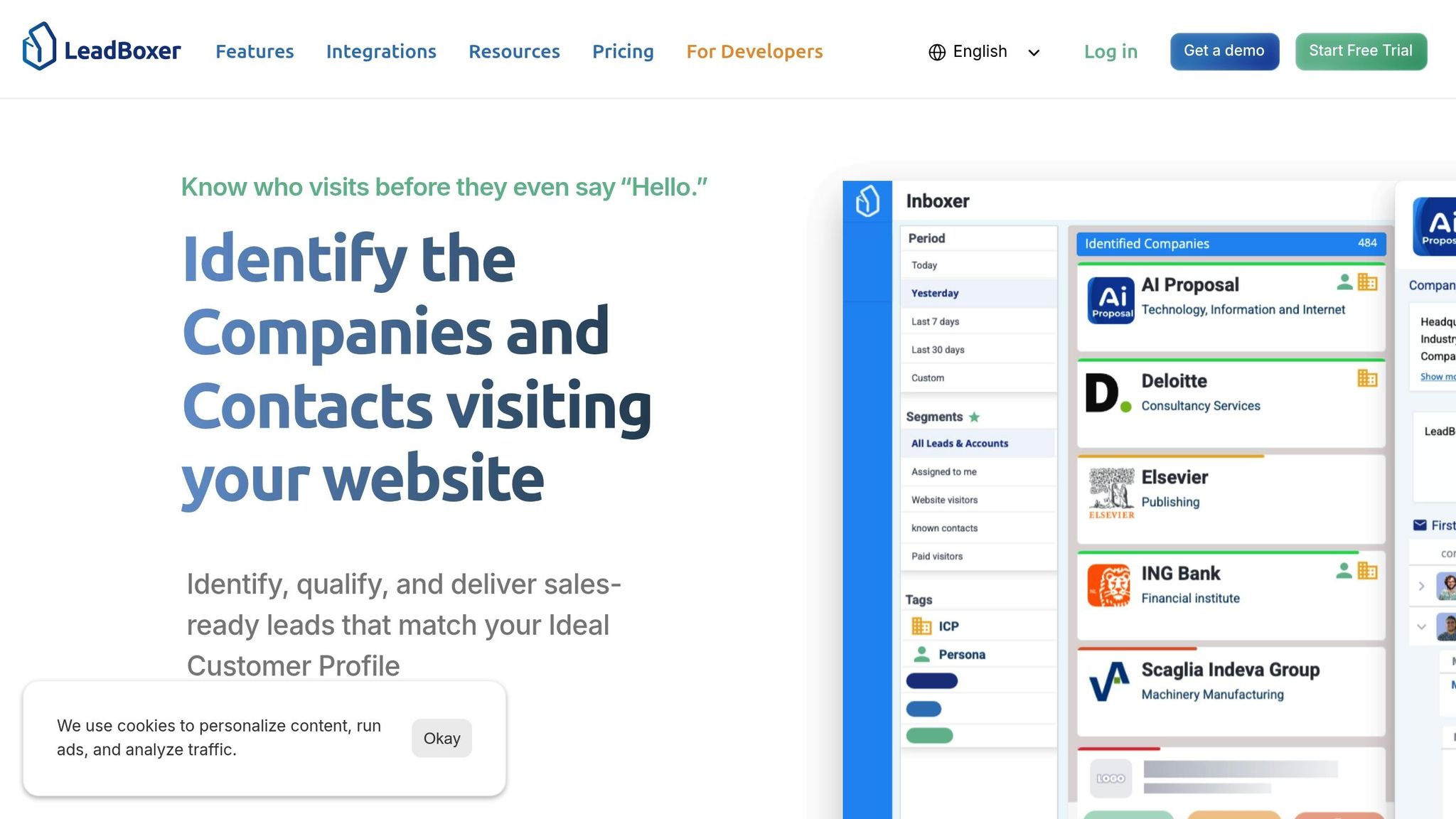
LeadBoxer offers a powerful platform for tracking and identifying website visitors. Using first-party cookie data and session tracking, it pinpoints businesses interacting with your site - even if visitors don’t complete contact forms. This gives you valuable insights into which companies are exploring your pages, what content they’re engaging with, and how long they’re staying.
The platform consolidates all visitor interactions into unified sessions and recognizes returning browsers, creating a continuous record of engagement.
A standout feature of LeadBoxer is its automated lead scoring system. By analyzing visitor behavior, the platform assigns scores to prospects, helping you focus on those with the highest buying intent. For instance, if a prospect repeatedly visits key pages, their score increases automatically, saving you time on manual research and prioritization.
To keep your team informed, LeadBoxer sends real-time alerts based on custom triggers, such as revisits or interactions with specific pages like demo requests. This ensures your team can act quickly when high-value prospects engage.
Additionally, LeadBoxer offers extensive rebranding options, allowing you to align the platform with your company’s identity.
White-Label Features
LeadBoxer’s white-label capabilities let you fully customize the platform to reflect your brand. From adding your logo and color scheme to using your domain name, the interface can be tailored to ensure clients see only your branding.
Beyond branding, the platform provides a robust API, enabling you to integrate its tracking and identification tools directly into your existing software. This gives you the ability to offer advanced lead generation features without building the infrastructure yourself. For those reselling the service, LeadBoxer offers discounted reseller plans along with marketing resources, making it easy to incorporate into your offerings.
Integration and Scalability
LeadBoxer integrates seamlessly with major CRM and marketing automation tools through pre-built connections and custom API options. When a lead reaches a specified score, the platform automatically updates your CRM - either by creating a new record or enhancing an existing one - eliminating the need for manual data entry and ensuring your records stay up to date.
This adaptability allows you to configure the system to meet your specific data routing needs. As your website traffic grows, LeadBoxer scales effortlessly to handle higher volumes. Its infrastructure supports thousands of page views simultaneously, maintaining real-time tracking even during traffic surges.
The Leadboard feature provides a visual pipeline for managing prospects. With an intuitive drag-and-drop interface, your team can easily move leads through different stages, from initial identification to becoming a qualified opportunity, all without disrupting established workflows.
These integrations and scalable features ensure smooth data management while keeping your operations secure and compliant.
Privacy and Compliance
LeadBoxer emphasizes privacy in its approach to data collection and storage. The platform’s first-party cookies do not store any personally identifiable information (PII). Instead, they identify returning browsers across sessions without collecting sensitive details. All data is securely housed in a private cloud environment.
For SaaS vendors, this privacy-focused framework simplifies compliance with evolving data protection laws. LeadBoxer’s cookie usage supports personalized content, targeted advertising, and traffic analysis, all while maintaining transparency through its clear privacy policy. This makes it easier to align with regulatory requirements while providing a secure user experience.
2. Alternative Solution A
Looking into alternative tracking engines uncovers notable differences in how they perform technically and the level of customization they provide.
Tracking and Identification Capabilities
Alternative Solution A relies on external data enrichment to identify anonymous visitors. However, it struggles with real-time accuracy. Its heavy dependence on IP-based identification becomes less reliable when users browse through VPNs, mobile networks, or shared public connections. Additionally, fragmented session tracking can lead to an incomplete picture of the customer journey. The platform's basic lead scoring, which primarily focuses on metrics like page views and time spent on-site, limits the depth of actionable insights.
Now, let’s turn to the customization options these platforms present.
White-Label Features
The extent of white-label customization varies greatly between tracking platforms. Some provide only basic branding options, such as swapping out logos or tweaking colors, while other interface elements remain generic, which can create a mismatched user experience.
Domain customization often comes at a premium price, and many platforms include "powered by" badges or watermarks that can’t be removed, potentially detracting from your brand’s professional image.
API access is another area where differences emerge. Some platforms restrict access to read-only functionality or impose strict rate limits, and the quality of their documentation can range from thorough and helpful to sparse and unclear.
Reseller programs also vary widely. While some platforms offer robust support, others provide little to no assistance, leaving you to handle technical questions, debugging, and even the creation of marketing materials on your own.
Integration and Scalability
Integration is another mixed bag. Many platforms claim compatibility with CRM systems, but these connections often require custom middleware or third-party tools. On top of that, pricing structures based on the number of identified companies or sessions can lead to unexpected costs. Performance may also suffer during periods of heavy traffic, adding another layer of complexity.
Beyond integration, privacy practices are a critical consideration.
Privacy and Compliance
Privacy policies differ significantly across platforms. Some still rely on third-party cookies, which modern browsers increasingly restrict. In addition, unclear data storage practices can make it harder to comply with regulations like GDPR or CCPA. Limited tools for managing user consent and excessive data collection only add to the compliance risks.
These factors underline important points for SaaS vendors to consider when choosing a white-label tracking engine.
3. Alternative Solution B
At this time, there’s no reliable information available regarding Alternative Solution B’s capabilities in areas like tracking, white-label functionality, integration, or privacy. This lack of data underscores the importance of conducting a deeper evaluation of its potential strengths and limitations in the next stages of analysis.
Strengths and Weaknesses
When looking at white-label tracking engines, certain features stand out for enhancing client services and boosting sales efforts. LeadBoxer provides a fully white-label solution with smooth CRM integration, allowing agencies to rebrand and deliver advanced lead generation tools without the hassle of extra technical work. Features like automated workflows and custom notifications make it easier to respond quickly to high-value leads. While LeadBoxer excels in these areas, there might be minor adjustments required during custom integrations. However, the platform’s functionality is backed by clear and straightforward feature insights.
One of LeadBoxer's standout qualities is its commitment to transparency. Its seamless integrations and scalability are complemented by detailed feature documentation, which showcases its leadership in the market. For more information, you can explore the platform overview, which provides valuable insights to support decision-making.
For businesses that prioritize flexibility in white-label solutions, LeadBoxer’s reseller plan is a strong option. It includes dedicated support, competitive pricing, and marketing resources, enabling agencies to present the platform as their own proprietary tool while still delivering powerful lead generation and qualification features.
Conclusion
Choosing the right white-label tracking and identification engine means carefully considering your integration needs, scalability goals, and branding priorities. These factors are essential when assessing a solution like LeadBoxer.
LeadBoxer delivers a white-label platform packed with features while maintaining ease of use. As highlighted earlier, it integrates smoothly with CRM systems and supports automated workflows, making advanced lead generation possible without requiring additional development. For a detailed look at its capabilities, check out the LeadBoxer section above.
The reseller plan adds even more value by including dedicated support, competitive pricing, and marketing resources, all designed to help you present the platform under your own brand.
When comparing platforms, focus on those that offer thorough documentation and clear feature descriptions. The LeadBoxer platform provides extensive details about its functionality, which is invaluable both during the selection process and throughout its use.
With its straightforward documentation and easy integration, LeadBoxer stands out as a practical choice for seamless implementation. Your clients demand reliable tools that provide actionable insights, and a dependable white-label partner like LeadBoxer ensures you can meet those expectations without unnecessary complications.
FAQs
What are the key benefits of using a white-label tracking and identification engine like LeadBoxer for SaaS vendors?
Using a white-label tracking and identification engine like LeadBoxer can offer SaaS vendors a range of practical advantages. For starters, it speeds up the time it takes to bring a product to market. Instead of building solutions from scratch, vendors can save time, cut development costs, and reduce risks. On top of that, these tools come packed with advanced technology designed to improve functionality and overall performance.
Another key benefit is the ability to enhance brand identity. Vendors can fully customize the platform with their own branding, ensuring a smooth and cohesive experience for their customers. Plus, white-label solutions are built to grow with your business, offering the flexibility to scale as your needs evolve. By tapping into these tools, SaaS providers can explore fresh revenue opportunities while staying focused on their primary business objectives.
How does LeadBoxer protect visitor privacy while tracking website activity?
LeadBoxer takes privacy seriously, employing strong technical and organizational safeguards to protect personal data. These steps not only secure user information but also ensure compliance with privacy laws during the tracking process.
The company is also dedicated to maintaining transparency, adhering to strict protocols that balance effective tracking with respect for individual privacy.
What should SaaS vendors look for in a white-label solution for lead generation and visitor insights?
When choosing a white-label solution for lead generation and visitor insights, it's important to weigh a few key factors carefully. First, customizability should be high on your list. A platform that can be tailored to match your brand and specific business needs makes all the difference. Equally important is scalability, ensuring the solution can grow alongside your business without missing a beat.
You’ll also want to look into the provider’s reputation and track record. A history of delivering dependable, effective solutions speaks volumes. On top of that, prioritize platforms that offer responsive customer support and smooth onboarding processes. These features can make it easier for your team to adapt and start seeing results quickly. By keeping these considerations in mind, you’ll be better equipped to select a solution that truly supports your SaaS business goals.
Related Blog Posts
Build on the LeadBoxer Platform
APIs for tracking, company identification, enrichment and scoring. The first 25,000 credits are free.