
Why Data Enrichment Matters for Inbound Leads
Add firmographic, contact, technographic and intent data to inbound leads for faster scoring, accurate routing, and better conversions.

A form fill is not enough. If I only get a name and work email, I can’t tell if the lead fits my market, who should own it, or how sales should reply.
Here’s the short version:
Bad or missing data slows sales down
Manual research wastes time
Weak lead data hurts scoring and routing
Fast enrichment helps teams reply sooner and with more context
The article makes one point clear: inbound leads need more than basic form data. When records are missing company, role, and behavior data, sales teams have to guess. That leads to poor qualification, slow handoff, and weak follow-up.
The numbers back that up:
62% of teams work with data that is 20% to 40% incomplete or wrong
Reps lose about 546 hours per year because of bad data
67% of lost sales tie back to poor lead qualification
Leads contacted within 5 minutes convert at 11.4%, vs. 0.6% after 24 hours
Enriched scoring can improve conversions by about 25%
What fixes this? I’d sum it up like this:
Add firmographic data like company size, industry, and location
Add contact data like title, team, and seniority
Add technographic and behavior data like tools used and page visits
Use that data to score, route, and reply right away
In short: enrichment turns a thin form fill into a lead sales can act on. It helps teams spend less time on research and more time on outreach that fits the account and the person.
A useful contrast from the article:
Area | Raw lead | Enriched lead |
|---|---|---|
Scoring | Based on form fields only | Based on fit, role, and intent |
Routing | Manual and slow | Rule-based and immediate |
Follow-up | Generic | More tailored |
The piece also explains how LeadBoxer fits into this flow. It adds company and contact data, tracks behavior, scores lead activity, and sends records into sales systems through APIs, webhooks, or CRM links.
So if I had to boil the whole article down to one sentence, it would be this: data enrichment gives inbound leads the context sales needs before the handoff happens.
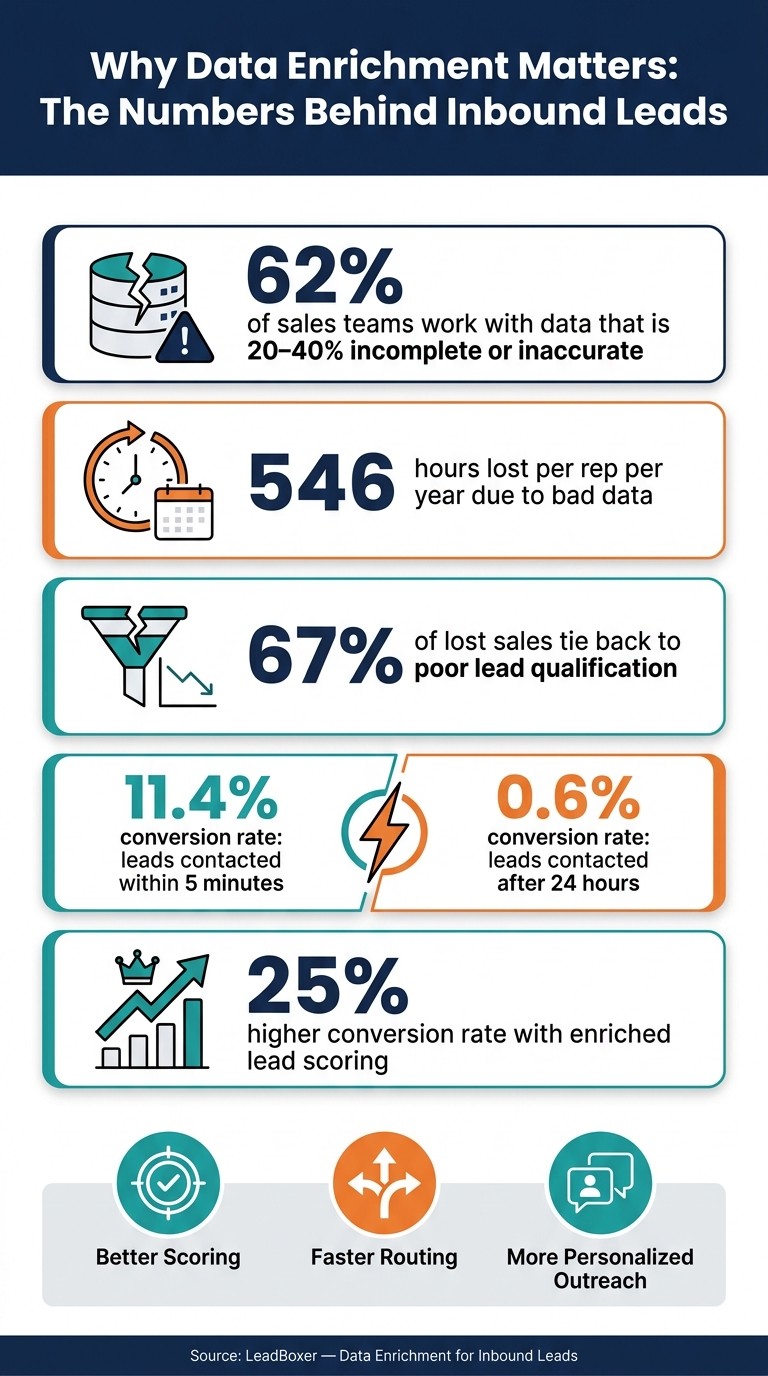
The Cost of Unenriched Inbound Leads: Key Data Points
What Is Lead Enrichment? A Complete Guide for B2B Teams
What goes wrong when inbound leads stay unenriched
When inbound data comes in half-empty, problems start fast. A lead with only a name and email forces manual triage at every step. Sales can't tell if the person fits the ICP, if they have buying power, or which rep should take the conversation.
Missing data weakens qualification and prioritization
Qualification runs on context: company name, domain, industry, employee count, revenue range, job title, seniority, location, and funding stage. If that fit and routing data isn't there, there's no solid way to know whether a lead belongs in the pipeline.
A director at a 500-person SaaS company and a student using a personal email can submit the same form. Enrichment is what separates qualified demand from noise. One should go to an AE. The other should go to nurture or get filtered out.
This also hits B2B lead scoring hard. Scoring models need firmographic and contact signals to rank leads by fit and buying readiness. When those fields are blank, the scores stop meaning much. A high-intent lead can score too low because the model can't confirm fit. At the same time, a low-quality submission can score too high just because it filled out a form.
SDRs already spend around 40% of their time researching prospects when data isn't enriched. That's time they could spend having actual conversations. Without enrichment, scoring reflects form fills, not fit.
The same lack of data also breaks routing.
Missing context slows routing and outreach
Routing needs to line up with territory, segment, and sales motion. If location data is missing, territory assignment falls apart. If company size or industry is missing, segment-based routing falls apart too. And without seniority, sales has no clear signal on whether to reach out right away or move the lead into nurture. The result is messy handoffs, duplicate work, and inconsistent routing.
The cost of that delay is steep. Leads contacted within 5 minutes convert at 11.4%, while leads reached after 24 hours convert at just 0.6%. That's a huge gap, and it's hard to make up when teams have to stop and research leads by hand. That context needs to be added before the sales handoff.
How data enrichment fixes the problem before sales handoff
The fix starts before sales ever sees the lead: enrich it at capture.
A form tells you someone showed interest. Enrichment tells you whether that person and company are a fit, what kind of account they belong to, and how your team should respond. When enrichment runs the moment someone submits a form or signs up, the record enters your system as something your team can use right away - not a thin contact record that sits there until someone looks it up.
Put simply, this works like an automated pre-handoff step. Each submission is matched, enriched, scored, and routed within seconds.
The data fields that make inbound leads actionable
The fields that have the biggest effect on qualification, routing, and personalization usually fall into four groups:
Category | Key Fields | Why It Matters |
|---|---|---|
Firmographics | Company name, domain, industry, employee count, revenue range, location | Confirms ICP fit and guides territory and segment routing |
Contact details | Job title, seniority, department | Shows decision-making authority and helps shape outreach tone |
Technographics | Current tech stack, tools in use | Shows integration fit and helps tailor messaging |
Buying signals | Funding stage, pricing page visits, content engagement, repeat visits | Points to urgency and buying interest |
A single form submission can append 30+ fields to the record. That’s the gap between a plain form fill and a profile with enough context to act on.
Real-time enrichment enables scoring, segmentation, and activation
Once the record is enriched, data-driven lead qualification models have stronger inputs to work with - verified company size, confirmed seniority, and the actual tech stack - instead of trying to infer intent from an incomplete form. Companies that use enrichment for lead scoring see about a 25% increase in conversions.
Segmentation gets sharper too. Teams can group leads by company size, funding stage, tech stack, and seniority, then send each group into the right workflow automatically.
High-fit leads can go to sales within minutes. Lower-intent leads can move into nurture right away. That’s the kind of real-time workflow LeadBoxer supports.
How enriched leads improve scoring, routing, and conversion
Once a lead is enriched, the next move is simple: score it, route it, and shape the follow-up automatically. With enrichment in place, the same inbound lead can be handled with verified data instead of guesswork.
Raw inbound lead vs. enriched inbound lead
The gap in day-to-day execution is easy to see:
Dimension | Raw Inbound Lead | Enriched Inbound Lead |
|---|---|---|
Scoring accuracy | Based on form fields alone and often unreliable | Driven by ICP fit, role, intent signals, and engagement |
Routing speed | Slow; often requires manual triage | Fast; automated rules run on standardized fields |
Personalization | Generic follow-up templates | Tailored to industry, role, and observed behavior |
Why better context leads to higher conversion rates
Better data leads to better scoring. When you add inputs like company size, industry, seniority, and pages visited, scores do a better job of predicting pipeline. Research shows a 40–60% improvement in lead scoring accuracy when enriched data is used.
That matters because score accuracy shapes what happens next. High-fit leads can be fast-tracked. Lower-fit leads can go into nurture. The same idea applies to routing. Rules only work well when fields like company size and location are standardized. If they are, routing can happen automatically instead of sitting in a queue for manual triage.
Conversion rates move too. Organizations using data-driven lead enrichment report about a 25% higher conversion rate and a 15% lower customer acquisition cost. A big part of that comes from personalization. If a rep knows a prospect's industry, company size, and which product pages they visited, they don't have to open with a generic pitch. They can get straight to what fits.
Intent data makes that timing even better. Intent data alone can shorten sales cycles by 30–40% when reps reach out at the right moment instead of sticking to a fixed cadence.
That only works if enrichment happens in real time, before the lead ever reaches sales.
How LeadBoxer supports inbound lead enrichment workflows
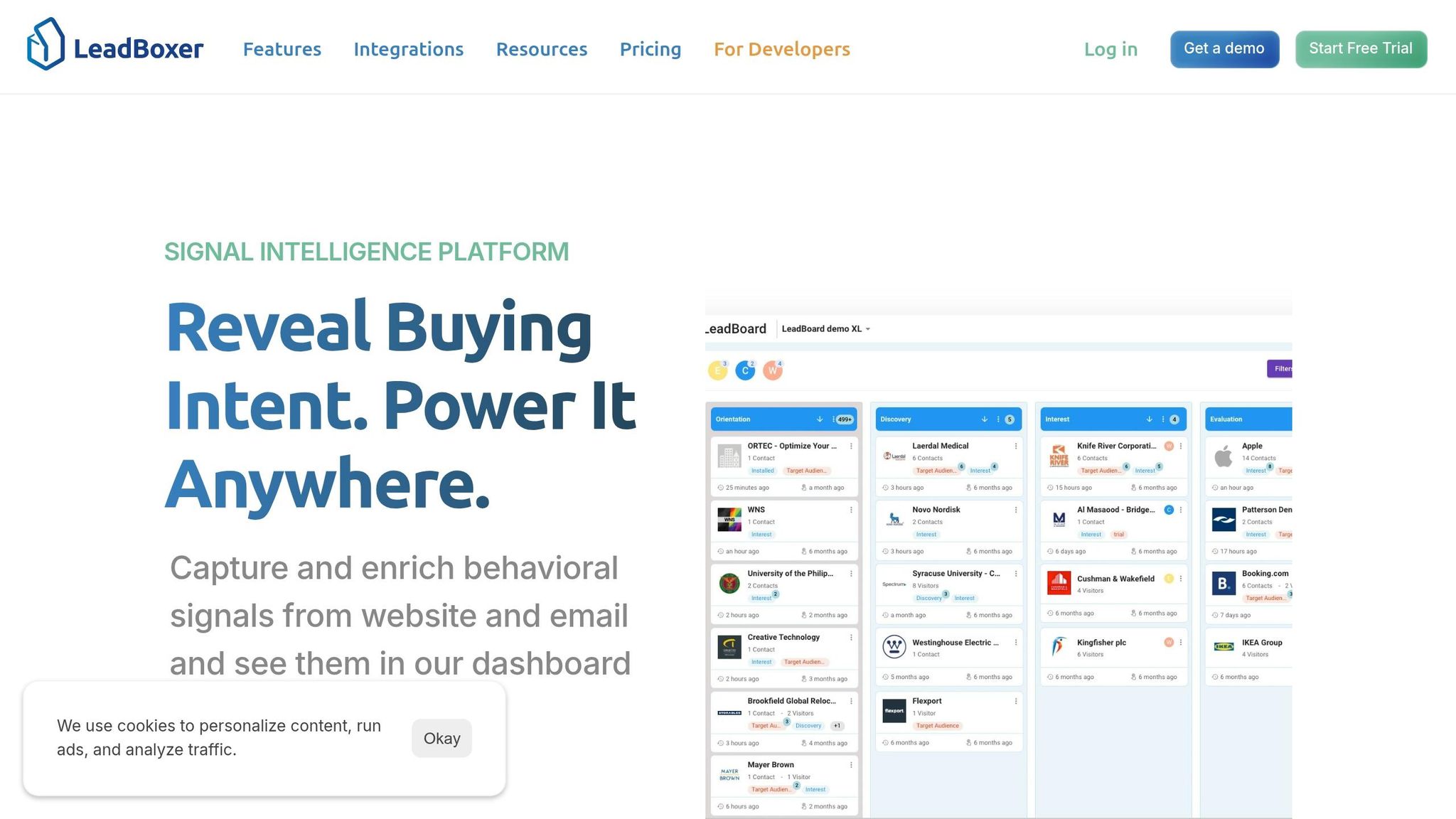
Using LeadBoxer to enrich and activate inbound leads in real time
Here’s how LeadBoxer puts enrichment to work right when a lead comes in.
LeadBoxer is an API-first lead enrichment platform. It builds enrichment into the inbound workflow, so leads get enriched as they enter the system.
LeadBoxer also captures behavioral events in real time and adds them to each lead record.
Before someone even fills out a form, LeadBoxer can identify anonymous traffic at the company level and append firmographic data. After conversion, it enriches the contact with role, seniority, department, and business email.
Then comes the part sales teams care about most: action. Once the record is enriched, that data can be used for routing and prioritization. LeadBoxer scores high-intent actions and exposes threshold alerts through APIs, webhooks, or CRM connectors. That means enriched leads can reach sales systems within seconds, without waiting for manual review. And if your team needs server-side enrichment from signups or event data, the Lookup API supports that too, without the tracking script.
That’s the heart of enrichment: less manual triage, faster response, and a better-qualified inbound pipeline.
Conclusion: Enrichment turns inbound inquiries into qualified opportunities
Enrichment turns inbound inquiries into qualified opportunities by improving fit, routing, and follow-up before sales steps in.
FAQs
What is data enrichment for inbound leads?
Data enrichment adds context and detail to the basic information you already have about an inbound lead.
If a lead comes in with only an email address or an anonymous IP address, enrichment helps fill in the blanks. It can add details like company size, industry, job title, and technology stack.
That gives your team a clearer profile to work with. And that makes it easier to qualify leads, tailor outreach, and decide who needs follow-up first.
Which data fields matter most for lead routing?
Prioritize the fields that tell you who the lead is and how well they match your ideal customer profile, such as:
company name, industry, size, and location
job title, seniority, department, and contact information
technographic data, like the software tools they use
Then layer in behavioral intent signals, like pricing page visits or content downloads. That gives you a clearer way to route leads by territory, product interest, or company fit.
When should inbound leads be enriched?
Inbound leads should be enriched as early as possible, then updated across the full lead lifecycle. That gives sales teams data they can actually use from day one.
Enrichment can start on a prospect’s first website visit, then grow through form fills, sign-ups, and downloads. And there’s a good reason to do it in real time: lead data decays by about 30% per year. Real-time enrichment helps keep profiles accurate, current, and useful for lead prioritization and more personal outreach.
Related Blog Posts

Supercharge your marketing results with LeadBoxer!
Analyze campaigns and traffic, segement by industry, drilldown on company size and filter by location. See your Top pages, top accounts, and many other metrics.


LeadBoxer
Get started