GDPR-Compliant, EU Data Residency With the LeadBoxer Platform
EU data residency reduces transfer risk, but GDPR compliance also requires consent, documented profiling, retention rules, and fast rights handling.

If you track EU website visitors, GDPR can apply to your U.S. team - and fines can reach €20,000,000 or 4% of global annual revenue. This article’s core point is simple: GDPR compliance and EU data residency are not the same thing, and you need both the legal process and the right data setup to cut risk.
Here’s the short version:
I see GDPR compliance as how data is handled: lawful basis, consent, profiling notices, rights requests, retention, and security.
I see EU data residency as where data stays: hosting, storage, processing, and access inside the EU/EEA.
A U.S. company can still fall under GDPR if it offers services to EU users or monitors their behavior.
Data like IP addresses, cookie IDs, work emails, and behavior data can count as personal data.
LeadBoxer’s main angle is to keep tracking, processing, and storage in EU-resident environments while using a company-first model and IP masking to cut personal-data exposure.
That does not remove the need for consent controls, scoring records, deletion workflows, or retention rules.
What matters most: if you use lead scoring, visitor identification, enrichment, or intent data tied to EU traffic, you need to check where the data goes, when tracking starts, how scores are explained, and whether access or deletion requests can be handled within one month.
Topic | Main point |
|---|---|
GDPR scope | U.S. companies can still be covered |
Personal data | IPs, cookie IDs, emails, and profiles may count |
Main risk areas | Consent, profiling, transfers, retention, rights requests |
EU residency | Cuts transfer risk, but does not equal full compliance |
LeadBoxer’s role | EU hosting, company-first identification, IP masking, API-based control |
What you still need | CMP setup, lawful basis records, scoring logs, deletion and suppression flows |
So if I had to sum up the article in one line, it would be this: LeadBoxer can lower GDPR risk for EU lead data, but only if your team pairs EU-resident infrastructure with clear consent, profiling, retention, and rights-handling rules.

GDPR Compliance vs. EU Data Residency: Key Differences & Risk Areas
What Is GDPR? | EU Privacy Law Explained: Rights, Principles, Fines & Compliance
The Main GDPR Risks in EU Visitor Identification and Lead Generation
The biggest GDPR risk usually isn’t just where data sits. It’s how teams track visitors, score leads, and keep data over time. That’s where problems tend to creep in. A lot of issues stay hidden until an audit happens or someone submits a rights request.
Lawful Basis, Profiling, and Consent: Where Teams Get Stuck
If you collect behavioral data from an EU visitor, you need a documented reason for doing it. GDPR calls that a lawful basis. And this choice matters.
For B2B tracking, many teams rely on legitimate interest. But that doesn’t mean you can just check a box and move on. You need a documented balancing test that shows your business interest does not outweigh the visitor’s rights.
Then there’s enrichment and lead scoring. This brings in profiling rules. In plain English, you need to document how scoring works and tell people that profiling is taking place. If a lead gets a score of 82 instead of 42, you should be able to explain why. Generic boilerplate language won’t cut it.
You also need to document the point where anonymous visitor activity gets tied to a form fill or CRM record. That link is part of your data processing lifecycle, and regulators may want to see how it works from start to finish.
Cross-Border Transfers, Retention, and Data Subject Rights Requests
When EU visitor data moves outside the EU, extra legal duties kick in. Standard Contractual Clauses can help make those transfers lawful. But after Schrems II, that’s not enough on its own. Each transfer also needs a Transfer Impact Assessment to check whether the destination country’s surveillance laws weaken those protections.
Retention creates another common weak spot. A lot of teams can’t say, in plain terms, how long they store behavioral signals, IP lookups, or enriched contact records. That’s a problem. Without defined Time-To-Live (TTL) policies, retention risk starts to pile up under GDPR.
Rights requests add day-to-day strain too. Under GDPR, you must handle deletion and access requests within one month. That sounds simple until lead data is scattered across tools that don’t talk to each other. Then a single "right to be forgotten" request can turn into a messy coordination task.
LeadBoxer anonymizes at storage level: it uses the IP address to identify the company, but does not write the IP address to disk. This keeps company-level identification useful while reducing personal-data exposure - a key consideration for B2B lead generation, since IPv6 addresses can identify unique devices and are classified as personal data under GDPR.
Comparison Table: Non-EU vs. EU Data Flows
Factor | Non-EU Data Flow | EU-Resident Data Flow |
|---|---|---|
Audit effort | Complex; requires mapping global data hops | Streamlined; single-region residency |
Sub-processor management | High complexity; multiple sub-processors | Lower; EU-owned and hosted infrastructure |
Documentation burden | Heavy; Transfer Impact Assessments required | Standard GDPR-native documentation |
IP handling | Full IP stored in logs | IP masking available; anonymized at storage level |
These are the main risk areas the LeadBoxer platform is built to reduce.
How LeadBoxer Supports EU Data Residency and GDPR-Aligned Data Handling
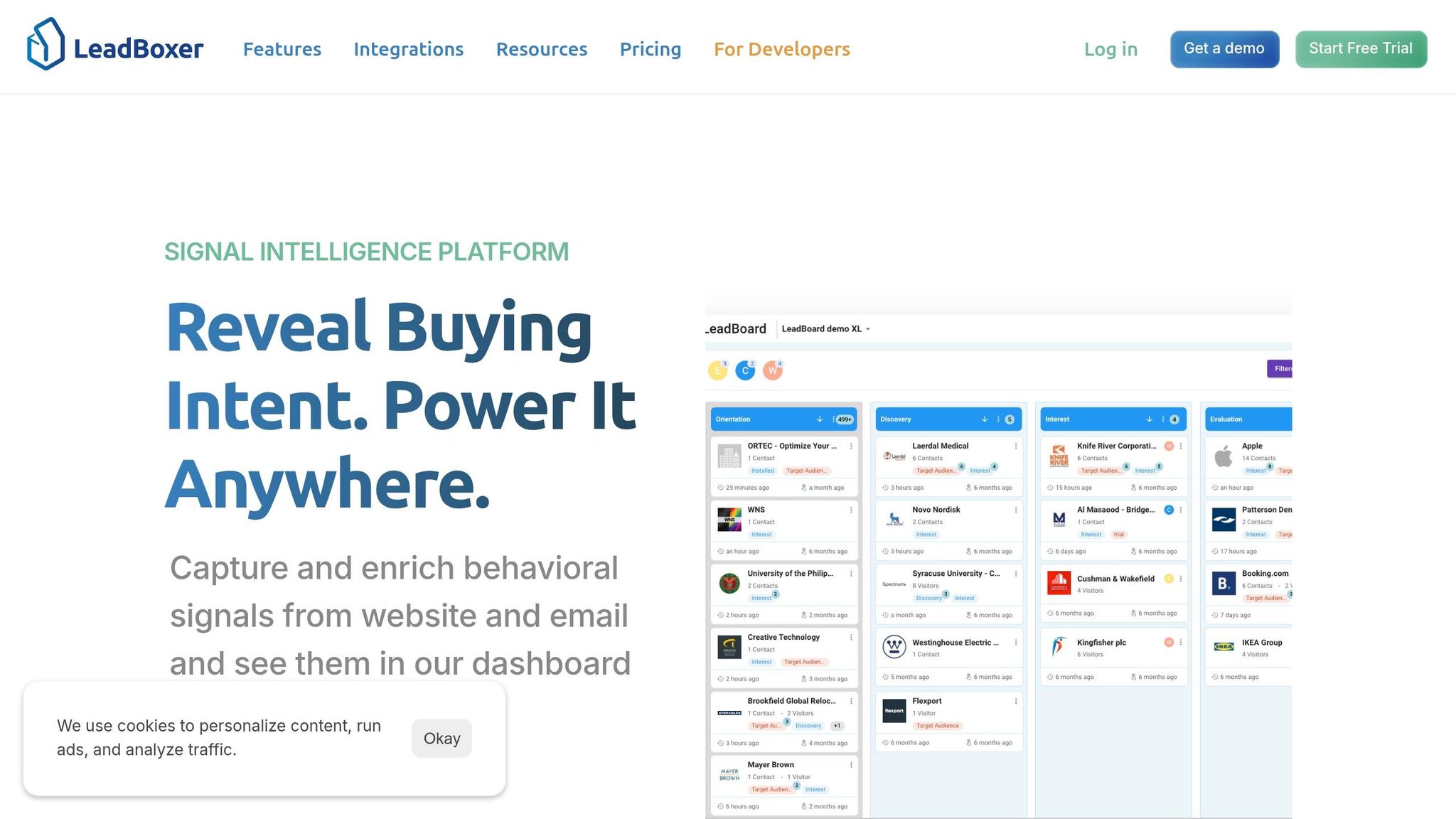
LeadBoxer is an API-first platform for tracking visits, identifying companies, enriching records, segmenting audiences, and scoring intent. Its tracking, processing, and storage stay inside EU-resident environments. That matters because it cuts down transfer risk in a very direct way.
EU Hosting and Storage: How LeadBoxer Reduces Transfer Risk
LeadBoxer runs in EU-hosted, load-balanced environments and uses ISO 27001-certified data centers. For compliance teams, that usually means shorter procurement reviews, simpler documentation, and fewer data handoff points to map and monitor.
Company-First Identification and Data Minimization
By default, LeadBoxer maps anonymous traffic to organizations, not people. It uses IP addresses to return firmographic data, such as industry, company size, and location, before any person-level data enters the picture. Names, email addresses, and other personal details only appear when a visitor submits a form or replies through email.
That setup lines up with GDPR data minimization and purpose limitation. Admins can tighten things further by turning on the ip-masking option in dataset settings. This sets both IPv4 and IPv6 addresses to zeros before anything is written to disk.
For B2B teams, this company-first model does something simple but important: it lets them spot revenue signals before they collect personal data. That gives compliance teams a cleaner starting point for consent, retention, and data rights workflows.
Next, the key question is how these residency controls support consent and data subject rights in practice.
Consent, Privacy Controls, and Data Subject Rights in Practice
Once EU data is minimized at the storage layer, the next checkpoint is simple: when LeadBoxer is allowed to collect it and score it.
Consent-Aware Tracking and Documented Scoring
Residency controls help, but they don't solve the whole problem. You also need to make sure tracking doesn't start before a visitor has given consent. For EU traffic, that means connecting LeadBoxer to a CMP so tracking, identification, enrichment, and scoring begin only after valid consent is in place.
Scoring also needs to be written down, not left as tribal knowledge. Your team should be able to show which signals shape each lead score, such as:
page visits
form submissions
identify website visitors at the company level
content interest categories
If a data subject or auditor asks how a contact was scored, you need a clear record that shows the scoring logic, the data inputs, and the purpose behind that processing. And that record can't sit still. As scoring rules and segmentation change, the documentation needs to change with them.
Teams that use LeadBoxer's server-side APIs have one more lever to pull. They can send server-side events only after the app has logged valid consent. In plain English: consent is enforced at the source, before the event ever gets sent.
Access, Deletion, Rectification, and Retention Workflows
Because LeadBoxer keeps visitor activity, company identification, scoring, and enrichment together in one system, a rights request usually starts with one query instead of a messy search across multiple tools.
From there, the workflow is pretty direct:
verify identity
export the record
fix errors
delete or suppress the record when needed
That last part matters. Suppression has to sync downstream so deleted contacts don't quietly show up again later.
Retention should also be split by data type. Active opportunities, dormant leads, and raw events shouldn't all live on the same timeline. It helps to log exceptions and deletion jobs, then check that backups follow the same policy. Calling out the exact controls that enforce retention, like scheduled deletion jobs, TTL policies by dataset, and suppression propagation, makes audits easier and cuts exposure without shutting off the signals your team still needs.
Table: LeadBoxer Capabilities Mapped to GDPR Safeguards
GDPR Safeguard | LeadBoxer Capability | Compliance Purpose |
|---|---|---|
Consent-aware tracking | CMP integration; server-side API event posting | Ensure non-essential tracking fires only after valid consent |
Data minimization | IP masking at storage level; company-first identification | Limit personal data exposure while still resolving companies |
Documented scoring | Configurable scoring logic with defined data inputs | Support audits and data subject inquiries with transparent records |
Right of access / portability | API-first architecture; full record export | Fulfill access requests with complete behavioral and profile data |
Right to erasure / suppression | Manual and API-driven deletion; downstream suppression controls | Remove records and prevent re-creation from the same identifiers |
Retention | Configurable TTL policies per dataset | Enforce retention schedules for dormant leads and raw events |
Access control | Tenant isolation; API key scoping | Restrict data access to authorized personnel during rights workflows |
Audit logging | Centralized record history; deletion logging | Provide evidence of policy execution for compliance reviews |
These controls also shape how marketing, sales, and product teams handle EU-resident intent data in day-to-day work.
How Marketing, Sales, and Product Teams Can Use LeadBoxer With Lower Compliance Risk
Marketing and Sales Workflows Built on EU-Resident Intent Data
These controls matter most when teams turn EU intent data into daily campaigns and outreach.
For B2B marketing and sales teams going after European accounts, the main upside of EU-hosted intent data is simple: you can act on buying signals without constantly wondering whether the data left the EU.
A demand generation team running account-based campaigns can use LeadBoxer to segment high-intent companies by firmographic fit, then trigger outreach sequences only for companies that match the ICP. If a contact opts out or sends a deletion request, suppression and deletion workflows should run before the next campaign goes live.
Document lawful basis for each processing activity, not as vague language in a privacy policy. For every segment or scoring rule, tie it to the exact basis - legitimate interest for company-level identification, consent for personal data capture - and make sure the data source lines up with that basis.
The same data layer can also support product and developer use cases.
Product and Developer Workflows Using LeadBoxer as a Central Data Layer
SaaS teams that want lead intelligence inside their products can centralize behavioral tracking, enrichment, and scoring in one governed data layer.
Developers can send backend events from CRM or billing systems through server-side APIs. That keeps data handling in one place, which makes governance easier.
This setup also makes Records of Processing Activities (ROPA) easier to manage. When tracking, enrichment, and scoring all happen through one platform, internal docs are simpler to keep up to date. Granular access controls - like limiting a regional team to only its own regional data segment - also help keep sensitive EU visitor data away from users or systems that don't need access.
Conclusion: What to Verify Before Adopting an EU-Resident Lead Intelligence Setup
Before adopting an EU-resident lead intelligence setup, verify four things:
Where data is stored, processed, and accessed under your contract
How consent is enforced in the system, not just described in a policy
Whether profiling and scoring logic can be documented clearly enough for an auditor or a data subject inquiry
Whether rights request workflows - access, deletion, and suppression - are live and tested, not just written down
LeadBoxer can lower GDPR risk across marketing, sales, and product workflows. It works best when it's part of a broader governance process that also includes your own legal review, a current ROPA, and clearly documented lawful bases for each processing activity.
FAQs
Does GDPR apply to my U.S. team?
Yes. GDPR applies to your U.S. team if your organization markets to or collects data from people in the European Union, no matter where your company is based.
GDPR covers how EU personal data is processed and stored. That means U.S. teams still need to follow those rules when they work with European prospects.
LeadBoxer supports this with a GDPR-native architecture, 100% EU-based data hosting, and data transparency tools.
Is EU data residency enough for compliance?
No. EU data residency is a core part of GDPR compliance, but by itself, it doesn't do the whole job.
You also need solid internal practices around how data is handled day to day. That includes auditing data processing, setting a legal basis for data collection, tailoring your privacy policy, and managing data subject rights like access, deletion, and the right to be forgotten.
How does LeadBoxer handle consent and deletion?
LeadBoxer puts clear user consent first before it processes identifiable data. It also offers tools like IP address masking, which can help with compliance without turning tracking into something overly invasive.
For deletion requests, LeadBoxer supports the right to be forgotten. That helps you handle requests to access or erase data. LeadBoxer provides the infrastructure as the processor, while you, as the controller, are still responsible for communication and for removing the data from your own systems on time.
Related Blog Posts
Build on the LeadBoxer Platform
APIs for tracking, company identification, enrichment and scoring. The first 25,000 credits are free.