The Missing Layer in Your SaaS Stack: Revenue Signal Intelligence
Use behavioral and product signals to detect buying intent, prioritize leads, and shorten SaaS sales cycles.

Your SaaS stack might look complete, but there's a critical piece missing: understanding when prospects are ready to buy. Revenue Signal Intelligence (RSI) bridges this gap by analyzing behavioral and contextual data to predict purchase intent.
Here’s why RSI matters:
Buyers spend only 17% of their purchase journey with vendors.
Sales reps spend just 30% of their time selling, with the rest lost to admin tasks.
Emails personalized with intent signals see an 18% response rate, compared to 8.5% for standard cold outreach.
RSI works by identifying high-intent signals like pricing page visits, product usage milestones, or key hiring trends. Accounts showing five or more signals convert at 44.3% and close 3.5x faster. By automating signal detection and scoring, RSI eliminates guesswork, helping your team focus on leads that matter.
Want to boost revenue, shorten sales cycles, and improve win rates? Start leveraging RSI to transform your sales strategy.
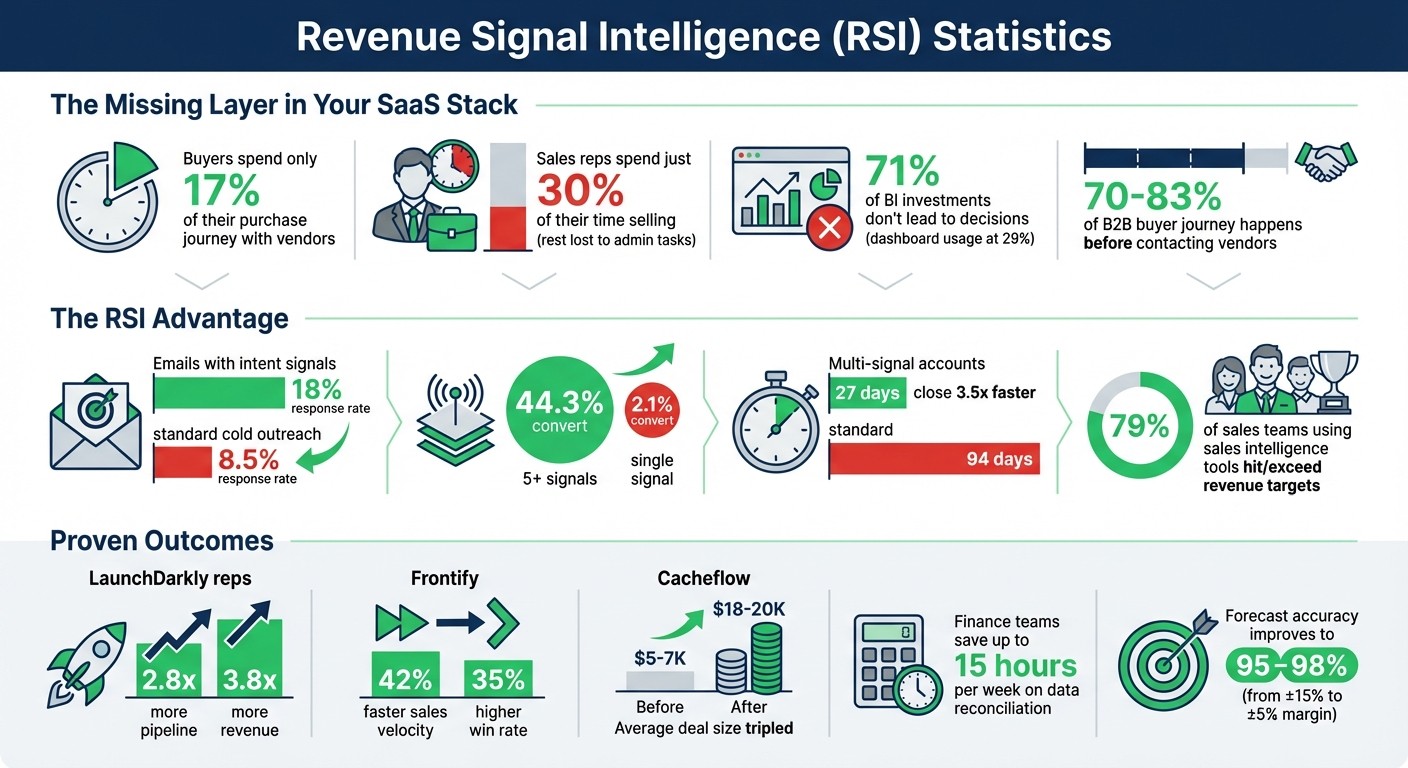
Revenue Signal Intelligence Impact: Key Statistics and Performance Metrics
What is Revenue Signal Intelligence?
Revenue Signal Intelligence (RSI) is all about identifying high-intent revenue opportunities by tracking and analyzing behavioral data - including activity from anonymous users. Unlike traditional lead generation, which focuses mainly on acquiring new leads at the top of the funnel, RSI takes a broader view. It monitors the entire revenue lifecycle, covering new business, customer expansion, and even churn prevention.
The shift here is from "pull" to "push." Traditional Business Intelligence (BI) tools require sales teams to dig through dashboards to find insights. RSI flips that script. It automatically detects patterns and sends actionable alerts directly to your team. Parse Labs explains it best:
Revenue intelligence inverts [traditional BI]: it answers the questions before you know to ask them.
Why does this matter? Because 79% of sales teams using sales intelligence tools consistently hit or exceed revenue targets. Meanwhile, dashboard usage rates remain stuck at just 29% - which means 71% of BI investments don’t actually lead to decisions. RSI addresses this by pulling together data from CRMs, billing systems, product analytics, and support tickets into one unified system. From there, it surfaces the most critical insights automatically.
How RSI Functions in SaaS Stacks
RSI works as an API-first data layer that connects your raw data sources to your go-to-market tools. It processes data in four key stages:
Behavioral analysis: Tracks engagement details like time spent on specific pages or research involving multiple stakeholders.
Identity resolution: Matches anonymous visitors to known CRM profiles.
Data enrichment: Adds firmographic details using tools like IP tracking.
Intent scoring: Assigns a score (usually 0–100) to measure the likelihood of commercial intent.
The most reliable data comes from first-party signals, such as product analytics, website interactions, CRM data, and support tickets. Second-party data (shared by partners) is the next best option. Third-party intent data, gathered from browsing networks, is less reliable and more probabilistic.
A great example of RSI in action comes from LaunchDarkly. In 2026, they used Pocus to unify scattered signals into a single system. Their sales reps who followed this signal-based process generated 2.8x more pipeline and 3.8x more revenue compared to those who didn’t. This shows how RSI fills the gaps left by traditional SaaS tools.
Why SaaS Stacks Need RSI
Traditional SaaS stacks often fall short when it comes to delivering actionable, timely insights. The main issues? Fragmented tools that don’t integrate well, data silos that hide key information, and missed opportunities due to delayed or manual processes. Without RSI, teams are stuck reacting to outdated data rather than acting on real-time signals.
Timing is everything. Buyer intent signals lose their impact quickly - a visit to your pricing page, for instance, drops below 25% intent after just one week. RSI solves this by automating pattern detection and eliminating manual tasks like reconciling data. For example, finance teams can save up to 15 hours per week by using RSI to match Salesforce ARR with billing systems like Stripe. RSI can even predict customer churn 30–60 days in advance with over 80% accuracy.
Mural, a visual collaboration platform, is another success story. By focusing on specific usage signals - like seat growth and cross-department feature adoption - they rebuilt their sales playbook. This signal-driven approach accounted for 45% of their quarterly pipeline in 2026. That’s the difference between guessing and knowing exactly when prospects are ready to buy.
Core Components of Revenue Signal Intelligence
A strong Revenue Signal Intelligence (RSI) system relies on three interconnected elements that transform raw data into actionable revenue opportunities. These components work in tandem - tracking user behavior, identifying the individuals behind those actions, and scoring their potential to convert. Let’s break down how each piece fits into the puzzle.
Real-Time Event Tracking
Everything starts with real-time event tracking. This step involves capturing user actions as they happen - whether it’s visiting a pricing page, submitting a demo request, engaging with features, or clicking on an email. Lightweight tracking tools, like JavaScript SDKs, log these activities instantly without affecting your site’s performance.
The most reliable data comes from first-party signals - your own systems, such as product analytics, website interactions, and CRM data. These inputs are accurate and timely. On the other hand, third-party intent data, often derived from broader browsing networks, tends to be less precise and can lead to missed opportunities when allocating sales resources.
Timing is everything. For instance, a visit to your pricing page has a "half-life" of just 48 hours and becomes far less relevant after five days. To keep your data actionable, your system must capture and act on signals quickly. Using score decay - where older signals lose weight over time - ensures your team focuses on fresh, high-priority leads.
Identification and Data Enrichment
Once real-time events are captured, the next step is adding context through identification and data enrichment. This process starts with identity resolution, which matches anonymous visitors to known profiles in your CRM. Then, data enrichment adds firmographic details like company name, industry, employee count, and revenue. For example, a vague observation like "someone from 198.51.100.0 visited the pricing page" becomes actionable intelligence: "ACME Corp, a 500-employee manufacturing company, just reviewed enterprise pricing."
This process unfolds in three stages: logging the event, matching it to a profile, and enriching it with business details. It’s important because roughly 70% of the B2B buyer journey happens in the so-called "dark funnel", where activities like anonymous browsing and AI-driven research go unnoticed. Without robust identification and enrichment, a significant portion of your pipeline could remain invisible.
Intent Scoring and Segmentation
The final piece is intent scoring, which helps prioritize leads based on their engagement levels. Each lead or account receives a numerical score (usually 0–100) based on their actions. For example, high-value behaviors like requesting a demo might add 25–30 points, while lower-value actions like opening an email might contribute around 15 points. This scoring method aligns perfectly with RSI’s mission to pinpoint revenue opportunities.
Modern systems are moving beyond individual scoring to focus on account-based intent. By analyzing combined signals from multiple stakeholders - such as three team members reviewing technical documentation within a week - you can identify buying committees in action. These accounts are prime candidates for outreach by senior sales reps.
AI-driven predictive scoring is also shaking up the game. Unlike static, rules-based models, machine learning systems update every few days using real win/loss data, which makes them increasingly accurate. Gartner estimates that by 2026, 75% of B2B sales teams will depend on AI for lead scoring. Early adopters are already seeing impressive results, with AI-scored pipelines delivering 2.5x more revenue per rep. To ensure timely action, you can set score thresholds (like 85/100) that trigger instant Slack or SMS alerts, helping your team engage prospects while their intent is still strong.
How to Implement Revenue Signal Intelligence with LeadBoxer
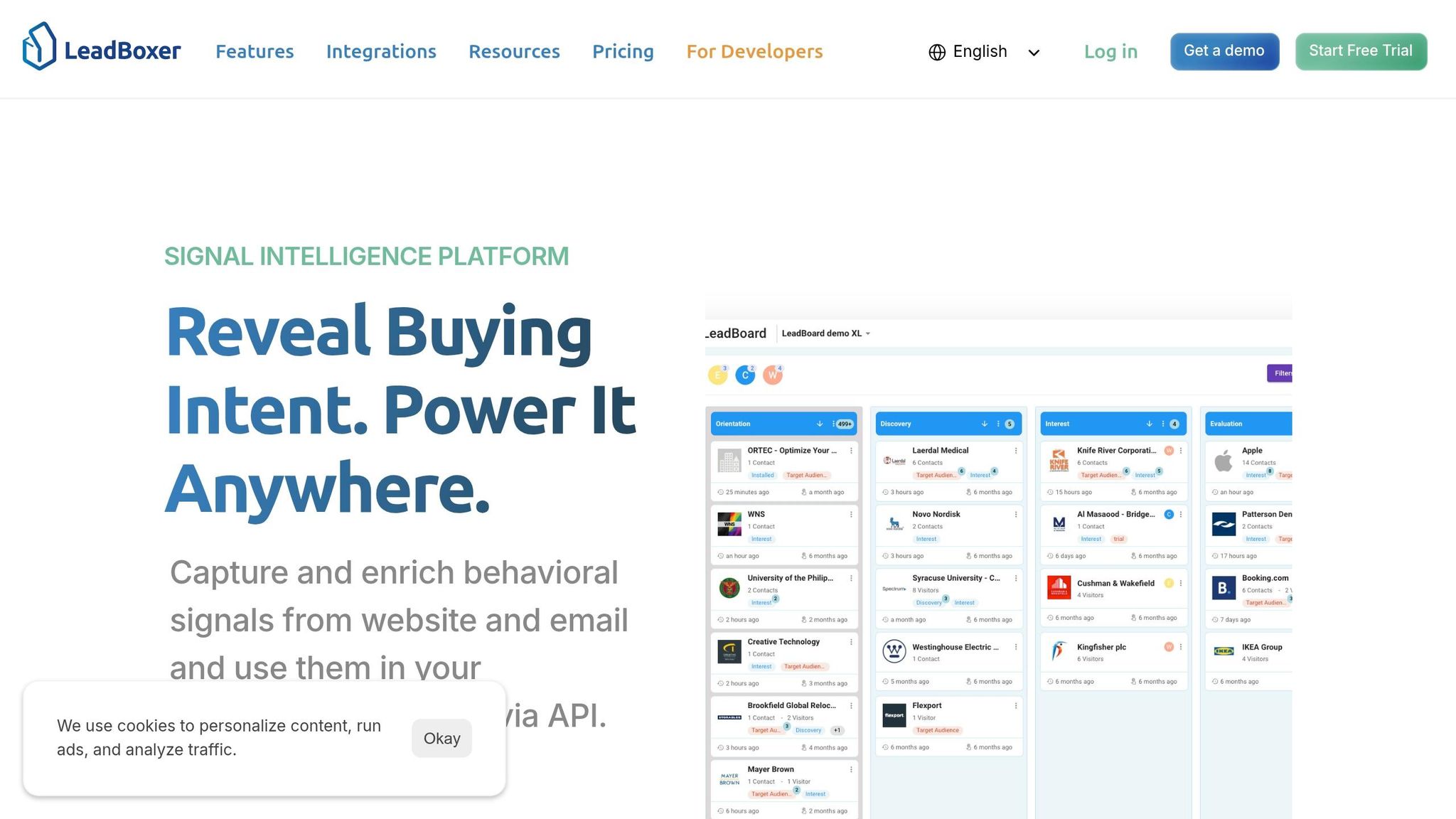
Getting started with Revenue Signal Intelligence (RSI) through LeadBoxer is straightforward. Thanks to its API-first design, there’s no need to overhaul your existing tools or workflows. LeadBoxer integrates smoothly, collecting data, enriching user profiles, and automating alerts - all without disrupting your current processes.
Using the RSI framework as a foundation, LeadBoxer provides the tools you need to turn insights into action in real time.
LeadBoxer Features and Benefits
At its core, LeadBoxer operates on a four-building-block data model: Users (Leads), Sessions, Events, and Properties. To begin, you can install the JavaScript SDK on your site, which captures events instantly without slowing down performance. For SaaS platforms, server-side tracking ensures reliable monitoring of key milestones like trial_started or subscription_upgraded.
LeadBoxer also excels at identity resolution, linking anonymous user behavior to identifiable profiles. Once a user is identified, data enrichment APIs add extra details such as industry, company size, and revenue.
Another key feature is intent scoring, which assigns a score (0–100) based on user engagement. You can also add unlimited custom properties (e.g., stage=evaluation or cta_clicked=true) to enhance profiles further. LeadBoxer integrates seamlessly with popular tools like Salesforce, HubSpot, Marketo, Pipedrive, and Zapier, enabling two-way data sync. This reduces manual enrichment time by up to 70% for sales teams.
Here’s an example of its impact: A marketing tech SaaS company used LeadBoxer to identify 300% more qualified leads from anonymous traffic, boosting its pipeline by $1.2 million in just six months.
Pricing and Scalability Options
LeadBoxer’s pricing model is designed to grow alongside your business, ensuring flexibility and cost efficiency.
The platform uses a credit-based pricing system, where credits cover activities like tracking visitors, IP lookups, company enrichment, and generating ideal customer profiles. The first 25,000 credits are free, and email opens or clicks don’t consume any credits. Beyond the free tier, pricing starts at $0.0005 per credit for 25,000 to 1 million credits. For higher volumes, rates drop to $0.0004 per credit for 1–3 million credits and $0.0003 per credit for 3–10 million credits.
Subscription plans range from the Starter plan at $99/month (1,000 credits) to the Growth plan at $299/month (5,000 credits). Enterprise options are also available for businesses needing custom credit volumes and dedicated support. For example, a startup might use just 500 credits monthly, while larger enterprises can process over 100,000 credits without incurring overage fees.
One case study highlighted how a company scaled from 200 to 20,000 credits per month without changing plans, achieving a 15% higher lead conversion rate. This pricing structure ensures you only pay for what you use, whether you’re managing 500 visitors or handling millions of events monthly.
Key Revenue Signals to Monitor
Revenue signals come in different forms, some pointing to immediate opportunities while others hint at potential future interest. Understanding which signals require swift action and which ones are better suited for nurturing can help you improve lead targeting and focus your efforts where they matter most. This distinction can often determine whether you close a deal quickly or waste time chasing a lead that doesn't pan out.
With B2B buyers completing 70%–83% of their journey before ever reaching out to a vendor - and 85% already having a shortlist of options ready - these signals might be your only glimpse into their decision-making process.
First-Party Intent Signals
First-party intent signals - actions taken directly on your website or within your product - are some of the clearest indicators of buying interest. Among these, visits to your pricing page stand out as the strongest signal. If someone visits your pricing page two or more times within a seven-day span, they’re actively comparing your offerings with competitors. The peak action window for this signal is within the first 24 hours; after 48 hours, the intent starts to wane.
Demo and trial requests are even more explicit signals, as they show a prospect is actively raising their hand. Responding promptly is critical: if you respond within five minutes, you’re 21 times more likely to qualify the lead compared to waiting 30 minutes. Beyond that, qualification rates plummet by 80%.
For product-led growth (PLG) SaaS companies, product usage milestones - like reaching feature limits, rapid seat expansion, or an uptick in active users - can indicate readiness for expansion or conversion. Case in point: in 2026, Linear used signals such as seat expansion and cross-team collaboration to pinpoint enterprise-ready accounts, boosting their Average Contract Value (ACV) by about 30%.
Engagement with high-intent content is another strong indicator. Downloads of late-funnel assets like ROI calculators, buyer guides, product comparisons, or API documentation often signal readiness to buy. Similarly, when multiple people from the same company engage with your emails within a 48-hour window, it could indicate internal forwarding and committee discussions.
"Signals have a half-life. The decay curve is steeper than most people assume. A pricing page visit at 2pm is a window into an active buying conversation. By day five, that window has largely closed."
Raj Bheda, Co-Founder, GainTrace
Beyond individual user actions, organizational changes can also reveal important buying signals.
Technographic and Hiring Signals
Technographic and hiring signals highlight organizational shifts that often lead to buying opportunities. These signals complement first-party actions, offering insight into a company’s internal changes and priorities. Hiring, for instance, is a strong predictor of purchasing intent. Companies typically hire before they invest in tools - after all, you can’t hire a team without budgeting for the resources they’ll need. Job postings often act as a direct roadmap to a company’s pain points and the technologies they’re ready to invest in.
The type of roles being hired can reveal specific needs. For example:
SDR or BDR hiring often signals a need for sales engagement platforms and data enrichment tools.
A surge in engineering hires might indicate plans to invest in cloud infrastructure or developer tools.
Security or CISO hires frequently trigger a comprehensive review of existing security vendor contracts within the first 90 to 100 days.
Marketing operations roles can point to upcoming investments in account-based marketing platforms or marketing automation tools.
Here’s a real-world example: In early 2026, a mid-market SaaS company with 200 employees posted 10 SDR job openings over two weeks following a Series B funding round. An SDR noticed this hiring surge and contacted the VP of Sales within 48 hours, focusing on the company’s scaling challenges. This led to a meeting and, ultimately, a $48,000 ARR deal closed within three weeks.
Technographic changes can also create ripple effects. For instance, when a company switches a core platform like a CRM, they often re-evaluate adjacent tools for integration and compatibility. Hiring a VP-level executive is another strong signal, with a 90% likelihood of a software stack change within the first six months. Additionally, new executives tend to spend 70% of their budget within their first 100 days.
"A company's job board is the most honest document it ever publishes. It is a raw, unfiltered list of their current pain points and exactly how much they are willing to pay to fix them."
Ibby Syed, Founder, Cotera
Building a Revenue Signal Intelligence Workflow
Creating a reliable Revenue Signal Intelligence (RSI) workflow goes beyond just identifying key signals. The real task lies in setting up a system that automatically detects these signals, routes them to the right team, and ensures swift action. Without the right setup, even the most critical signals can get buried - lost in dashboards or scattered across disconnected tools.
An RSI workflow integrates seamlessly with your CRM, billing systems, and customer success platforms. The goal is to move from a "pull" model, where teams manually search for insights, to a "push" model that delivers actionable intelligence directly into their daily tools and processes. This shift allows for automated detection that transforms raw data into meaningful, ready-to-act alerts.
Automated Detection and Real-Time Alerts
At the heart of an RSI workflow is automated signal detection. This involves connecting all your data sources - like website tracking, CRM data, billing systems, and product usage logs - into a unified intelligence layer that monitors activities in real time. LeadBoxer’s API-driven design simplifies this process, capturing live events and enriching anonymous data into actionable profiles.
Once signals are flowing, the next step is setting up threshold-based alerts. Not every action deserves attention - a single blog visit isn't enough. But a combination of actions, like a pricing page visit followed by a demo request within 24 hours, should trigger an alert. For example, you can set a threshold score of 85 out of 100, ensuring that only high-intent leads trigger notifications [12, 14]. This approach prevents alert fatigue and helps sales reps focus on leads that are ready to convert.
The scoring system should evaluate four key factors:
Depth: How close the action is to a purchase decision.
Frequency: How often the behavior occurs.
Seniority: The rank of the individual involved.
ICP Fit: How well the company matches your ideal customer profile.
For instance, a CFO visiting your pricing page multiple times in two days from a company that aligns with your target industry and size would score much higher than a junior analyst casually browsing your blog.
To keep the system focused on fresh opportunities, implement score decay. This prevents stale leads - those that have delayed or abandoned their buying decisions - from resurfacing.
Alerts should appear where your team already works, like Slack, CRM tasks, SMS, or WhatsApp. For example, when Frontify introduced automated account intelligence in 2025, they routed alerts directly into their sales team’s Slack workspace. This reduced manual research time by 90%, sped up sales cycles by 42%, and quadrupled self-sourced revenue. Once high-intent alerts are in place, the next step is acting on them quickly and efficiently.
Lead Prioritization and Targeted Outreach
After detecting high-intent signals, the focus shifts to prioritizing and responding effectively. Hybrid scoring models - combining firmographic data with real-time behavioral signals - help rank leads. A common split is 60% behavior and 40% profile fit, ensuring your team targets not only active leads but also those that align well with your product.
Clearly define handoff thresholds between marketing and sales. For example:
Leads scoring above 85 transition to Sales Qualified Leads (SQLs) and should be contacted within 15 minutes.
Leads scoring between 60 and 84 undergo further qualification by an SDR.
Leads below 60 remain in automated nurture campaigns [13, 14].
Speed is critical. Companies that respond to leads within an hour are seven times more likely to engage decision-makers. For top-priority signals - like demo requests, pricing page visits, or security document downloads - set a 15-minute response SLA. If a rep doesn’t act within that timeframe, escalate the alert to a manager or reassign it automatically.
Prepare pre-built templates for specific triggers, such as hiring spikes or technology shifts, to enable quick, personalized outreach. This preparation allows reps to respond in minutes with messaging tailored to the detected signal.
Between 2024 and 2025, Cacheflow adopted this approach to target larger accounts. By automating the identification of strategic buying signals and cutting prep time by 60%, they tripled their average deal size from $5,000–$7,000 to $18,000–$20,000 in just a year.
"Now that our team isn't drowning in manual research, they can truly focus on execution, which is priceless for a startup."
Adam Wainwright, Head of Revenue at Cacheflow
Finally, don’t rely on a single point of contact. Engage 4–6 key stakeholders within the target account, including executives, end users, and technical evaluators. This multi-threaded approach builds consensus and ensures deals keep moving forward.
Measuring the Impact of Revenue Signal Intelligence
A well-executed Revenue Signal Intelligence (RSI) workflow can boost revenue, shorten sales cycles, and improve close rates. The effectiveness of RSI is measurable through specific, actionable metrics.
Metrics to Track
Start by monitoring the signal-driven pipeline percentage. This metric shows how much of your sales pipeline originates from detected signals compared to cold outreach or inbound vs outbound marketing. Companies with mature RSI programs typically see 40–60% of their pipeline driven by signals. If you're just starting, expect 15–25% in the first six months, with growth as your team becomes familiar with the system and scoring models improve.
Another key metric is the signal-to-opportunity conversion rate, which measures how many high-intent signals turn into qualified opportunities. Early-stage programs convert around 8–12%, while mature systems achieve 18–28%. For example, in 2025, LaunchDarkly unified product signals into a single intelligence layer. Reps who used the signal-based approach generated 2.8x more pipeline and 3.8x more revenue compared to those who didn’t, all within one quarter.
Win rates and sales velocity also highlight RSI’s impact. Companies using real-time scoring often see 40% faster pipeline velocity and 35% higher win rates. Frontify, for instance, implemented real-time account intelligence in 2025, leading to a 42% faster sales velocity and a 35% higher win rate, while quadrupling self-sourced revenue. Similarly, Dropbox improved sales productivity by 25% in 2024 by using People.ai, which automated sales activity tracking and eliminated manual data entry.
RSI also supports Net Revenue Retention (NRR) and churn prevention. It helps identify at-risk customers early, improving save rates from 25% to 45–65% as the program matures. Additionally, tracking the expansion capture rate - upsell and cross-sell success based on usage signals - can boost results from 40% to over 65%.
Lastly, measure forecast accuracy. Traditional forecasting typically has a ±15% margin of error, but automated revenue intelligence narrows that to ±5%, with accuracy reaching 95–98%. It also reduces the "Days-to-Detection" for critical signals from 6–8 days to just 24 hours, giving your team a significant competitive edge.
Metric Category | KPI | Typical Improvement |
|---|---|---|
Lead Generation | Signal-to-Opp Conversion | 18–28% (Mature programs) |
Sales Efficiency | Research Time Reduction | 60–90% |
Sales Velocity | Deal Cycle Length | 20–35% shorter |
Revenue Impact | Expansion Capture Rate | Increase from 40% to 65%+ |
Retention | At-Risk Save Rate | 45–65% |
Forecasting | Forecast Accuracy | 95–98% |
Tracking these metrics ensures your RSI system is delivering results, but consistent optimization is key to long-term success.
How to Optimize Your RSI System
Refining your RSI system ensures it stays aligned with buyer behavior. Use these strategies to make continuous improvements:
Segment your data by company size and industry. Different signals predict conversions for different segments. For instance, a VP hire might indicate high intent for mid-market companies, while founder activity on a pricing page could be more relevant for startups. Tailoring scoring models for each segment ensures leads are routed effectively and reps focus on the right prospects.
Conduct retroactive audits of recent closed-won deals. Review the signals present 30 days before the deal closed to fine-tune your routing thresholds. This approach ensures your scoring model reflects actual buying behaviors rather than assumptions.
Set signal expiration rules in your CRM. Signals have a short half-life, peaking within 0–24 hours and becoming irrelevant by day five. Auto-archiving outdated signals keeps dashboards clean and ensures reps focus on actionable opportunities.
"The patterns in your misses teach you more about your process than almost anything else."
Raj Bheda, Co-Founder, GainTrace
Establish a scoring council with members from Sales, Marketing, and RevOps. Meet monthly to review conversion rates, SLA adherence, and model performance. This prevents "model drift" and ensures your RSI system evolves with buyer behavior.
Conclusion
One signal alone doesn’t tell the full story - it’s just noise. But when you stack multiple indicators, like pricing page visits, key hires, and content downloads, a clearer picture of buying intent emerges. Accounts showing five or more concurrent signals boast a conversion rate of 44.3%, compared to just 2.1% for accounts with a single signal. Even better, these multi-signal accounts close deals in an average of 27 days, far faster than the 94-day average for single-signal deals.
Automated RSI workflows take lead qualification to the next level. They replace outdated manual processes, which cost $35–$100 per lead, with systems capable of processing thousands of leads daily for just $5–$25 per lead. Not only are they more efficient, but they also boost accuracy from 70–80% to an impressive 85–95%. This doesn’t eliminate the need for human judgment; instead, it frees your team from repetitive digital tasks, letting them focus on engaging with high-intent prospects. And all of this is powered by an integrated, API-first solution.
Our API-first platform seamlessly combines real-time tracking, enrichment, and behavior-based lead scoring into a single, streamlined system. Whether you’re a startup testing the waters with a pay-as-you-go plan or a high-volume enterprise on the Scale tier, the credit-based model adapts to your growth. With this, you can embed revenue intelligence directly into your workflows and products.
Start with your first-party signals - like product analytics, CRM data, and website behavior. To keep your outreach laser-focused, set a 24-hour signal expiration, ensuring your team targets only fresh, high-intent leads. Build stacking logic to trigger outreach only when multiple indicators align. When done right, these strategies can transform your pipeline. Mature programs often generate 40–60% of their total pipeline from signals alone, while cutting deal cycles by 20–35% compared to traditional methods.
Want to bridge the gap in your SaaS stack? Check out LeadBoxer’s solutions and start converting anonymous traffic into a qualified pipeline today.
FAQs
What signals matter most for my SaaS?
When it comes to growing your SaaS business, the most telling indicators are those that shed light on customer behavior, revenue patterns, and areas where growth is possible. Some of the critical signals to monitor include anonymous user activity, engagement trends, and buying intent.
By combining multiple data points - such as website visits and user interactions - you can unlock actionable insights. These insights can help you predict revenue streams, speed up lead qualification, and boost conversion rates.
On top of that, AI-powered tools can add another layer of value. They can identify potential churn risks or highlight upsell opportunities, giving you the ability to make smarter, data-backed decisions while scaling your business efficiently.
How do you score intent without spamming sales?
Scoring intent without bombarding potential buyers with sales pitches hinges on leveraging revenue signal intelligence. By analyzing behavioral data - such as website visits, engagement patterns, and technographics - AI-powered tools can identify genuine buyer interest and assign scores based on how likely a lead is to convert.
This method allows sales teams to prioritize prospects with the highest potential. It also supports tailored outreach efforts, ensuring interactions are informed by data and respectful, steering clear of blanket messaging or unsolicited cold calls.
What’s the fastest way to set up RSI in my stack?
The fastest way to get started with Revenue Signal Intelligence (RSI) is by leveraging a single API layer. This approach automates the entire process - collecting, enriching, and qualifying raw event data - so you can turn anonymous user actions into actionable sales signals in no time.
By embedding tracking and enrichment features directly into your product, you can:
Capture user activities seamlessly.
Enrich the data with firmographics for deeper insights.
Stream these signals straight into your workflows.
This method not only saves time but also reduces the need for extensive setup and infrastructure.
Related Blog Posts
Build on the LeadBoxer Platform
APIs for tracking, company identification, enrichment and scoring. The first 25,000 credits are free.