
From Pageviews to Pipeline: Turning Behavior into Sales Signals
Convert anonymous website behavior into prioritized sales leads with identification, intent scoring, CRM sync, and fast outreach.
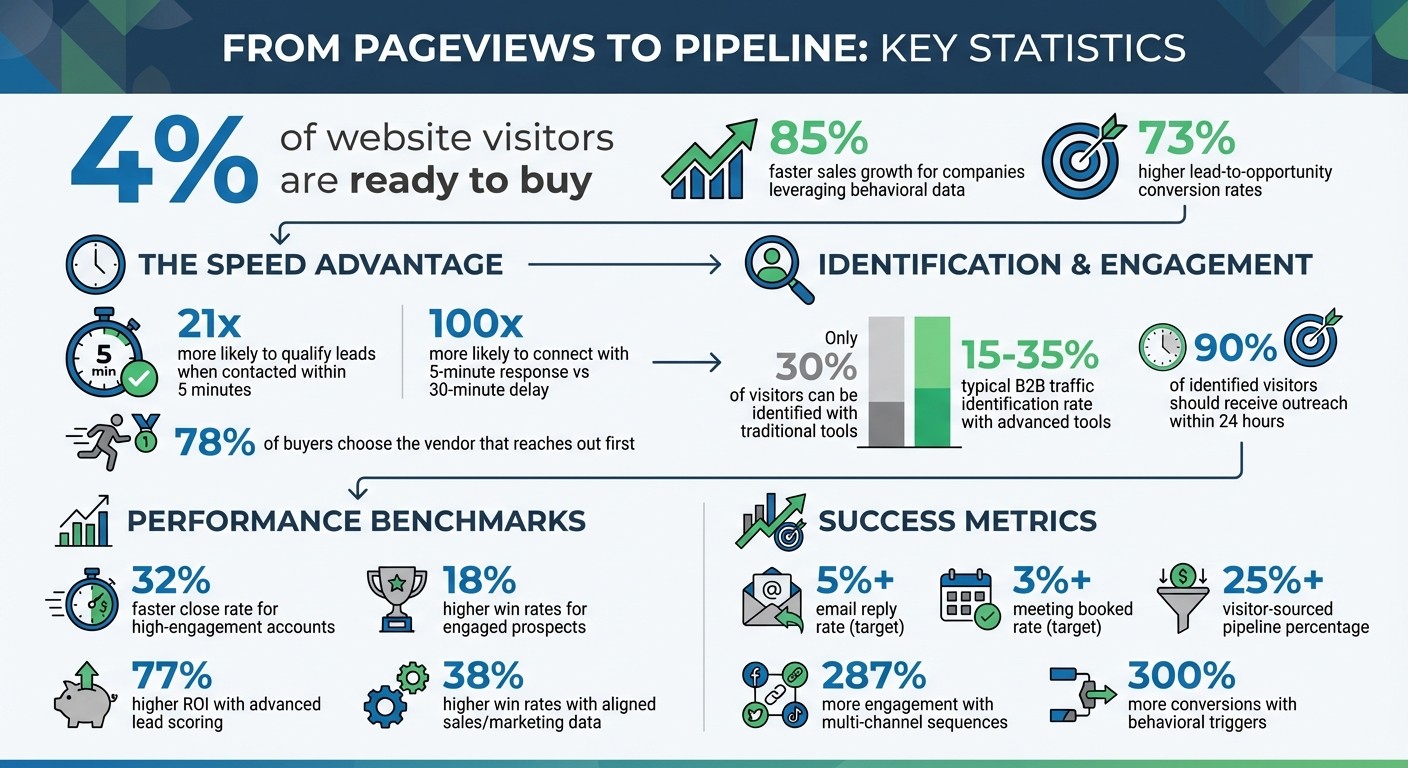
Your website traffic holds more than just numbers - it’s a source of sales insights. But here’s the catch: only 4% of visitors are ready to buy. The challenge isn’t just attracting traffic; it’s spotting these ready-to-buy leads and acting fast. Companies leveraging behavioral data see results like 85% faster sales growth and 73% higher lead-to-opportunity conversion rates.
Key Takeaways:
Behavioral Data Matters: Actions like pricing page visits or demo requests signal high intent.
Timing is Critical: Contacting leads within 5 minutes makes you 21x more likely to qualify them.
Tech to Watch: Tools like reverse IP lookup and identity graph matching help identify anonymous visitors.
Lead Scoring: Assign points to actions like downloads or page views to prioritize outreach.
CRM Integration: Syncing behavioral data with CRMs ensures sales teams act on insights immediately.
By tracking and acting on visitor behavior, you can turn anonymous clicks into real revenue opportunities.
Website Visitor Behavior to Sales Conversion: Key Statistics and Metrics
The Challenge of Anonymous Website Traffic
What Anonymous Traffic Means for B2B Websites
Anonymous traffic refers to visitors who explore your website without leaving behind identifiable information. For B2B companies, these visitors are often early-stage researchers. They’re digging into case studies, comparing pricing, or reviewing security documentation, but they remain invisible to your sales team.
This challenge has grown as browsers increasingly block third-party cookies and users turn to incognito modes or VPNs. Traditional tracking methods are struggling to keep up. Even with IP enrichment tools, platforms like Google Analytics can only identify about 30% of visitors - and even then, shared or residential networks often lead to inaccuracies.
"Google Analytics is brilliant at telling you what happened, but it's legally and technically designed to keep visitors anonymous."
– marqeu
Analytics platforms are designed to protect privacy by summarizing data rather than tying behaviors to specific accounts. While this safeguards user anonymity, it also creates a major disconnect for sales teams. Without the ability to link website activity to CRM systems or trigger timely sales alerts, valuable insights slip through the cracks.
This lack of visibility doesn’t just hinder immediate engagement - it can also leave a gap in revenue opportunities.
The Revenue Cost of Unidentified Visitors
The financial impact of anonymous traffic is hard to ignore. When prospects stay unidentified during their research phase, sales teams miss out on engaging them at a critical moment - when they’re actively comparing solutions. By the time someone fills out a "Contact Us" form, they may have already made up their mind or even chosen a competitor.
Without proper identification, it’s nearly impossible for sales teams to separate high-value prospects from casual browsers. For instance, if a CMO reports a 40% spike in website traffic but can’t pinpoint which target accounts are behind it, sales teams may dismiss the data as irrelevant. This lack of clarity turns potentially actionable insights into noise, leaving sales teams unable to prioritize leads or act strategically.
The numbers back this up: accounts with high engagement scores close 32% faster and have 18% higher win rates compared to unidentified or low-engagement prospects. Without knowing who’s visiting your site, you’re left guessing - unable to focus on the right leads, prove ROI, or act when it matters most.
How Visitor Identification Technology Works
Core Technologies for Visitor Identification
Visitor identification uses a mix of advanced techniques to turn anonymous website visits into actionable insights. Here's how it works:
Reverse IP lookup: Matches IP addresses to business registries, identifying the company behind the visit.
Session stitching: Employs first-party cookies to link anonymous actions to a visitor once they reveal their identity.
Device fingerprinting: Creates unique signatures based on browser attributes, helping to distinguish individual devices.
Identity graph matching: Compares browser signals against verified identity databases to uncover person-level details like names and LinkedIn profiles.
Identity graph matching operates through two methods. Deterministic matching uses direct, verified data (e.g., logins) for nearly perfect accuracy. On the other hand, probabilistic matching relies on statistical patterns, offering 60% to 80% accuracy. Most platforms combine these approaches to boost identification rates, which typically identify 15% to 35% of total B2B traffic. Beyond identification, this process delivers insights that help prioritize leads and align them with sales strategies.
Connecting Anonymous Sessions to Company and Contact Data
After gathering behavioral data, the next step is enriching it with firmographic and contact-level intelligence. Once a visitor is identified, the system taps into third-party databases to retrieve:
Firmographic data: Details like company name, industry, employee count, annual revenue, and tech stack.
Contact-level data: Information such as job title, seniority, work email, and LinkedIn profile.
This enrichment transforms an IP address into a full prospect profile that sales teams can use. However, many tools only identify companies, not individuals. For example, you might learn that "someone from Google visited your pricing page", but not who they are or if they’re a decision-maker. That’s where contact intelligence tools like LinkedIn Sales Navigator or ZoomInfo come into play, helping pinpoint the right individuals within the identified company.
Data Type | Insights Provided |
|---|---|
Firmographic | Company name, industry, employee count, annual revenue, tech stack |
Behavioral | Pages viewed, time on site, scroll depth, video plays, repeat visits |
Contact-Level | Name, work email, job title, seniority, LinkedIn profile |
Geographic | City, state, ZIP code, ISP name |
Setting Up Behavioral Tracking for B2B Sales
What to Track: Key Behavioral Data Points
It's all about spotting the actions that point to revenue potential. For instance, a visit to your pricing page tells you a lot more about intent than someone casually browsing a blog post about industry trends.
Focus on high-intent website interactions. Pay close attention to visits to pricing pages, product feature sections, case studies, testimonials, and FAQs. These behaviors often carry more weight. Session duration is another clue - visitors who spend over five minutes or check out three or more pages are likely serious. Actions like viewing pricing or product pages can be worth double the score of a general pageview.
Content engagement and progression through B2B marketing funnels are equally revealing. Keep an eye on downloads of gated content (like whitepapers or eBooks), video engagement (especially demo completions), and forms filled out by visitors. A demo request form, for example, signals immediate interest, while a newsletter signup shows they’re just starting to explore. Look for patterns: prospects moving from early-stage content (e.g., blog posts) to decision-stage resources (e.g., ROI calculators or pricing tools) are often closer to converting than those sticking to top-of-funnel content.
Email and communication behaviors provide another layer of insight. Track open rates, click-throughs, and replies to your outreach. Pay special attention to advocacy signals - like when prospects forward your emails to colleagues. In the B2B world, internal sharing often signals the formation of a buying committee, which is a strong indicator that a deal is progressing.
Don't ignore negative signals. Track periods of inactivity, unsubscribes, or engagement with irrelevant content. These actions should lower a prospect’s score, helping your sales team focus on leads with active intent rather than wasting time on cold opportunities.
"Without a defined set of actions, your marketing team might pitch leads that aren't ready to move on to the sales process. Overall, this will slow down your sales team." - HubSpot
Behavioral Signal | Score Impact | Intent Level |
|---|---|---|
Demo requests | 25–30 points | Immediate sales readiness |
Pricing/product page visits | 10–15 points (2x weight) | High intent |
Email opens (70%+ rate) | 15 points | Strong buying intent |
Whitepaper downloads | 8 points | Medium-term nurturing |
General page views | 5–15 points | Awareness/low intent |
With these behaviors identified, the next step is to structure your data so it directly informs your sales strategy.
Organizing Data for Actionable Insights
Once you've mapped out the key signals, the challenge is turning this information into something your sales team can act on. Raw data is just noise unless it’s well-organized and accessible.
Bring all your data together. Combine website analytics, email platform stats, and CRM data into a unified timeline of activity. Companies that align their sales and marketing data report 38% higher win rates.
Standardize your CRM inputs. Make fields like deal stage, lead source, and expected close date mandatory. This ensures clean, consistent data for better segmentation and forecasting. Regularly clean your database - removing duplicates and standardizing naming conventions for leads and deals is critical for meaningful insights.
Categorize interactions. Tag each activity with attributes like industry, product line, region, and deal type. This allows for advanced filtering. For example, enterprise leads in healthcare might prioritize security documentation, while small businesses might jump straight to pricing.
Automate data collection. Use tools that automatically log emails, meetings, and website visits into your CRM. This reduces manual errors and ensures no interaction is missed. Set up real-time alerts for high-intent actions, such as multiple visits to pricing pages or downloads of key product guides.
Add time-based weighting. Recent actions are more relevant than older ones. For instance, a pricing page visit from yesterday carries more weight than one from six months ago. Regularly review your scoring system - monthly audits and quarterly updates ensure your model stays aligned with actual conversion trends.
"Lead scoring is more art than science, blending data with insightful human judgment. Getting it right could be the difference between meeting your quarterly targets or exceeding them." - Manny Ruan, Marketing Specialist, Gradient Works
The ultimate goal? Build a system where your sales reps can immediately see not just who engaged with your content, but what they did, when they did it, and why it matters. With 96% of website visitors not ready to buy, identifying the 4% who are - and reaching out within five minutes - makes you 100 times more likely to connect.
From 12% to 40% Close Rate: The Smart CRM Lead Scoring System Every B2B Company Needs
Converting Behavior into Sales Signals
Turn pageviews, downloads, and clicks into actionable insights that guide your sales outreach.
A well-structured lead scoring system can be the difference between productive sales teams and those wasting time on uninterested leads. Companies with advanced lead scoring frameworks report a 77% higher ROI on lead generation. The secret lies in distinguishing genuine buying interest from casual browsing.
Lead Scoring Methods Explained
Once you’ve organized behavioral data, the next step is assigning scores to these actions. Here are three primary lead scoring strategies, each suited to different sales models and data availability.
Activity-based scoring focuses on individual actions - like email opens, pageviews, or content downloads. It’s straightforward and ideal for high-volume lead generation with shorter sales cycles. For example, visiting a pricing page might earn 15 points, while reading a blog post could add 2–3 points. The downside? It measures activity but doesn’t necessarily predict outcomes.
Account-based scoring looks at the collective activity of multiple stakeholders within a single organization. Instead of evaluating individuals in isolation, it considers the broader interest of the company. For instance, if several team members from the same business visit your pricing page within a short time, it signals organizational intent rather than just individual curiosity.
Intent-based (or predictive) scoring leverages machine learning to identify behaviors tied to successful deals in the past. This approach uncovers patterns in historical data rather than relying on assumptions. For example, a SaaS company using predictive scoring saw a threefold increase in win rates for top-scored accounts and shortened sales cycles by 40% for accounts scoring above 70.
"Traditional lead scoring measures activity. P2B scoring predicts outcome. Those are fundamentally different things." - Michael Torres, Prospectory Team
Scoring Method | Focus | Best For | Key Advantage |
|---|---|---|---|
Activity-Based | Individual actions | High-volume lead gen, short sales cycles | Simple to implement and understand |
Account-Based | Aggregated engagement across a company | Enterprise B2B with complex buying teams | Highlights organizational intent |
Intent-Based | Predictive analysis using AI | Companies with robust historical data | Identifies patterns and predicts outcomes |
Many organizations find success by blending these approaches. A common strategy is to balance "Fit" (firmographic data like industry or company size) with "Intent" (behavioral signals), often using a 60/40 split. This ensures you’re targeting prospects who align with your ideal client profile and show active interest.
To keep scores relevant, apply decay to older signals and subtract points for actions that suggest poor fit - like visiting your careers page or using a personal email address.
These scoring techniques help sales teams transform behavioral data into targeted outreach efforts, turning anonymous clicks into revenue opportunities. By refining your framework, you can zero in on the behaviors that truly signal buying intent.
How to Identify and Prioritize High-Intent Prospects
Focus on actions that suggest active evaluation.
Group signals by urgency:
Tier 1 signals: Demo requests, pricing page visits, or ROI calculator usage demand same-day follow-up.
Tier 2 signals: Case study downloads or webinar attendance should prompt outreach within 48 hours.
Tier 3 signals: Blog reads can be nurtured through weekly email campaigns.
Look for patterns, not one-off actions.
A single visit to your pricing page might not mean much, but consistent engagement tells a different story. For example, if a prospect visits your pricing page three times, downloads a case study, and requests a demo - all within five days - that’s a strong indicator of buying intent. Analytic Partners implemented this approach in 2026 under Andrew Giordano, VP of Global Commercial Operations, and saw a 40% increase in qualified pipeline year-over-year. Sales reps also cut their account research time from 3 hours to just 15 minutes by leveraging automated signal clusters.
"Most sales teams think they have a timing problem. They don't. They have a signal problem." - Semir Jahic, CEO at Salesmotion
Define clear thresholds for action.
Leads scoring 80–100 should immediately go to an account executive.
Scores between 60–79 should enter an SDR sequence within 48 hours.
Scores from 40–59 can be placed in a marketing nurture track.
Anything below 40 stays in automated nurturing.
Give extra weight to bottom-of-funnel actions.
High-intent behaviors like demo requests (+25 points), pricing page visits (+15), or ROI calculator usage (+20) should carry more weight than lower-intent actions like homepage visits (+2) or newsletter signups (+3). Leads scoring 70 or higher often experience sales cycles that are 40% shorter than those of less engaged prospects.
Track the entire engagement journey.
The story of a prospect’s journey - starting with a blog post, moving to a demo video, and culminating in a pricing page visit - provides deeper insight than any single action alone.
Keep this in mind: B2B buyers are typically 70–80% through their decision-making process before reaching out to vendors. Your job is to identify and engage them during this silent evaluation phase, before they finalize their vendor shortlist. While only 24% of companies report excellent ROI from intent data, the main issue isn’t the technology - it’s the lack of speed and relevance in acting on these signals. Success depends on both the tools you use and how quickly and effectively you respond.
Connecting Behavioral Data to Your Sales Pipeline
Once you've identified and scored behavioral signals, the next step is integrating these insights into your sales process using marketing and sales automations. Behavioral data only becomes impactful when it’s accessible to the people who can act on it - your sales team. The challenge lies in delivering this data to your systems with the right context and at the right time.
Syncing Behavioral Data with CRMs and Automation Tools
The key to effective integration lies in identity resolution - linking anonymous activity to identified profiles. This happens automatically when a visitor performs an identifiable action, such as clicking on an email link, submitting a form, or logging in. Once identified, their entire behavioral history is added to their CRM record, giving sales reps a detailed view of their engagement.
IP-to-company matching is another powerful tool. It identifies the companies visiting your site even before they submit a form. This allows you to initiate account-based marketing workflows early, targeting organizations showing interest before direct contact is made.
When syncing data, it’s important to map custom properties to specific CRM fields. For instance, instead of burying behaviors like "three visits to the integrations page" in generic logs, map them to dedicated CRM fields. This gives sales reps quick, actionable insights into a prospect’s specific interests.
To keep your pipeline focused, implement automated lead qualification before data enters the CRM. Use scoring models that weigh both engagement levels and how well the lead matches your Ideal Customer Profile. This ensures your sales team spends time on high-fit, high-intent prospects, keeping the CRM clutter-free and efficient.
Once your CRM is enriched with this detailed data, the next step is ensuring that leads are routed to the right sales reps without delay.
Routing Leads Based on Behavioral Signals
Once your data is integrated, routing leads quickly and accurately becomes critical. Timing is everything - responding within the first 5 minutes is 21 times more effective than waiting 30 minutes. Set up real-time alerts for high-intent actions like visiting your pricing page or submitting a demo request. This allows sales reps to respond immediately.
Establish clear routing rules based on behavioral signals. For example, demo requests should prompt outreach within 5–60 minutes. Prospects who visit your pricing page or return to your site multiple times in a week should be contacted within 4 hours. Lower-intent actions, like reading a single blog post, can be routed to automated nurture sequences. These rules, combined with your lead scoring strategy, help prioritize high-intent leads.
Multi-threading can also accelerate deal closure. Instead of engaging just one contact, involve 2–3 key decision-makers, such as the end user, economic buyer, and technical evaluator. This approach has been shown to increase deal velocity by 25–40%.
Every routed lead should include a context brief. Sales reps should have a clear picture of which pages the prospect visited, how much time they spent, and what content they engaged with. This allows for personalized outreach that speaks directly to the prospect’s interests. Avoid mentioning tracking explicitly; instead, tailor your messaging to align with the customer’s demonstrated needs.
"90% of website visitor identification data sits unused in dashboards." - MarketBetter
The gap between collecting data and acting on it is where most revenue opportunities are lost. By automating lead routing, setting up real-time alerts, and providing context-rich handoffs, you can turn behavioral insights into meaningful, timely conversations that drive results.
Measuring Results and Improving Over Time
Making the most of behavioral data isn’t just about gathering it - it’s about measuring the right metrics and refining your strategy to drive sales. The biggest missed opportunities often lie in the gap between collecting data and acting on it. To close that gap, you need to track meaningful metrics and adjust your approach based on what the data tells you.
Here’s a closer look at the key metrics to focus on and how to use them for continuous improvement.
Metrics That Matter for Tracking Success
Start by evaluating identification-to-outreach efficiency. This measures how effectively you’re turning identified visitors into actionable leads. Ideally, over 90% of identified visitors should receive outreach within 24 hours, and at least 80% should receive outreach overall. These numbers reveal whether your process is effectively converting data into action.
Another key metric is lead-to-opportunity conversion rates. This validates your scoring model by showing whether high-scoring leads consistently convert better than medium-scoring ones. Companies with structured lead qualification systems often achieve conversion rates up to 73% higher.
Speed-to-lead metrics are also critical. These track the time between a high-intent action and your team’s response. The faster your follow-up, the better your chances of engaging the lead.
Metrics like email reply rates and meeting booked rates provide insight into how well your outreach resonates. Aim for reply rates above 5% and meeting booked rates above 3% - these benchmarks indicate that your behavioral insights are driving personalized, timely conversations.
Finally, monitor the visitor-sourced pipeline percentage, which should account for at least 25% of your total pipeline. If behavioral data isn’t contributing significantly, it might be time to reassess your identification methods or lead routing processes.
How to Refine Your Approach Based on Data
Once you’ve established these metrics, use the insights to fine-tune your strategy.
Start by analyzing conversion correlation. Look at which behavioral signals - like visits to a pricing page versus reading a blog - are more likely to result in conversions. Adjust your scoring model to prioritize the signals that consistently lead to closed deals. Conduct this analysis quarterly, with weekly reviews to spot emerging trends.
Introduce score decay to keep your scoring model relevant. Over time, reduce the weight of older behavioral signals so that scores reflect current intent. For example, a pricing page visit from yesterday should carry more weight than one from three months ago. Align decay periods with your typical sales cycle.
Consider switching to real-time dynamic models that adapt as behavior changes. Unlike static demographic scoring, AI-driven models that incorporate behavioral data can improve lead conversion rates by 27% and boost team productivity by 10%.
"Lead scoring is more art than science, blending data with insightful human judgment. Getting it right could be the difference between meeting your quarterly targets or exceeding them." - Manny Ruan, Marketing Specialist, Gradient Works
Establish a feedback loop between sales and marketing teams. Regularly share insights on lead quality and conversion outcomes, and use this feedback to adjust scoring weights and refine your Ideal Customer Profile during monthly or quarterly reviews.
Maintain clean data to avoid undermining even the best scoring models. Remove duplicates, update outdated firmographic details, and purge inactive contacts regularly. Automating these processes can help ensure your data remains accurate and actionable.
Before implementing any changes, use A/B testing to validate updates to scoring criteria or outreach templates. Controlled testing ensures that your optimizations are based on measurable results rather than assumptions.
Keep an eye on threshold velocity - how quickly leads move from "nurture" to "sales-ready." If certain behaviors consistently accelerate progression, increase their weight in your model. Similarly, reduce or remove signals that rarely contribute to lead advancement.
Conclusion
Turning website traffic into revenue hinges on using behavioral data to drive immediate sales action. Surprisingly, 90% of website visitor identification data remains untouched, sitting idle in dashboards. As MarketBetter aptly puts it:
"the gap between 'identified' and 'contacted' is where pipeline goes to die".
The companies excelling today go beyond tracking metrics like pageviews. They focus on identifying high-intent behaviors, responding quickly, and engaging decision-makers across buying committees. Businesses that establish structured workflows to move visitors into their sales pipeline report that leads sourced from website visitors contribute 15–30% of their total pipeline within just six months.
Speed is a game-changer in this process. Responding to leads within five minutes significantly boosts connection rates, and 78% of buyers choose the vendor that reaches out first. However, speed alone isn’t enough - effective outreach must address a prospect's unique challenges with precision.
To maximize results, adopt a streamlined, data-driven approach. Start by identifying visitors, enriching their profiles, scoring their intent, and routing them to the appropriate sales reps. Measure your success with actionable benchmarks: aim for reply rates above 5%, meeting booked rates over 3%, and ensure that 90% of high-intent leads receive outreach within 24 hours. Continuously refine your strategy by analyzing what drives the highest conversion rates and adjusting your scoring models accordingly.
The potential here is immense. Multi-channel sequences triggered by behavioral signals can deliver up to 287% more engagement and 300% more conversions compared to relying on email alone. Your visitors are already signaling their needs - act decisively to turn that intent into revenue. By integrating behavioral data into your sales process using our API-first lead intelligence platforms, you can transform insights into meaningful, revenue-generating actions.
FAQs
How can I identify anonymous B2B website visitors without third-party cookies?
To figure out who’s visiting your B2B website without relying on third-party cookies, you need privacy-friendly strategies. Techniques like IP-to-company matching, behavioral analytics, and AI-powered enrichment can help. These tools work by analyzing visitor IP addresses, tracking on-site actions, and studying engagement patterns. The result? You can uncover company information and even predict visitor intent - all while respecting privacy regulations.
You can also use server-side tracking and data enrichment to create detailed visitor profiles based on their behavior. This approach not only keeps you compliant but also helps you identify high-intent prospects effectively.
What behaviors should count most in a B2B lead scoring model?
In a B2B lead scoring model, it’s crucial to zero in on behaviors that signal strong buying intent and active engagement. Actions like visiting high-value pages - such as pricing or demo pages - downloading resources like whitepapers, attending webinars, or interacting with emails (like clicks and replies) are clear indicators of interest. These behaviors suggest that a lead is further along in their journey and more likely to convert. By prioritizing these signals, you can pinpoint high-quality leads, sharpen your sales team’s focus, and streamline your pipeline for better efficiency.
How do I route high-intent leads to sales in real time from my CRM?
To connect with high-intent leads quickly, leverage behavioral data and lead scoring to pinpoint and prioritize the most promising prospects. Tools like LeadBoxer can track key signals, such as pageviews and user engagement, to assess lead intent.
For example, when a prospect visits pricing pages or requests a demo, these actions indicate strong interest. At this stage, platforms can automatically push the lead to your CRM. From there, alerts or workflows can be triggered, ensuring your team follows up right away. This streamlined approach maximizes your chances of converting high-intent leads into customers.
Related Blog Posts

Supercharge your marketing results with LeadBoxer!
Analyze campaigns and traffic, segement by industry, drilldown on company size and filter by location. See your Top pages, top accounts, and many other metrics.


LeadBoxer
Get started