Why Every SaaS Product Needs Built-in Lead Intelligence
Built-in lead intelligence turns anonymous SaaS visitors into prioritized, high-intent leads with real-time tracking, enrichment, and scoring.

73% of website visitors remain anonymous - and that’s a big problem for SaaS companies. Without knowing who these visitors are or their intent, you’re left guessing about their needs and missing out on potential leads. Add to that the fact that 79% of leads never convert because sales teams waste time on unqualified prospects, and it’s clear: traditional lead generation methods are falling short.
Built-in lead intelligence solves this by integrating real-time visitor tracking, intent data analysis, and automated lead scoring directly into your SaaS platform. It identifies anonymous visitors, analyzes their behavior, and prioritizes high-intent leads for your sales team. The benefits? 3.2x higher conversion rates, 28% shorter sales cycles, and 37% lower acquisition costs.
Here’s how it works:
Tracks visitor behavior (e.g., pricing page visits, scroll depth).
Matches visitors to company data using tools like IP mapping.
Scores leads based on actions, urgency signals, and engagement.
Sends real-time alerts to sales teams for follow-up.
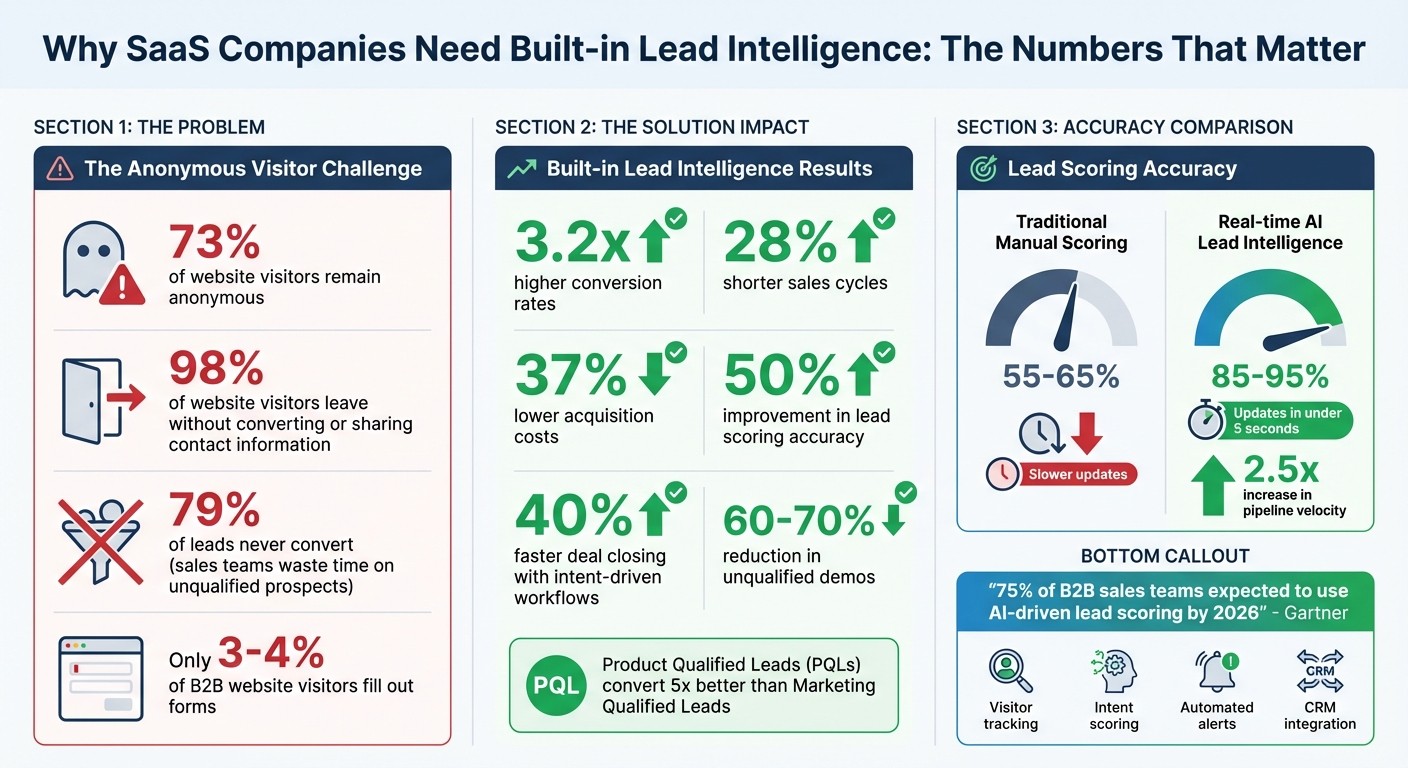
Lead Intelligence Impact: Key Statistics for SaaS Conversion Rates and ROI
Benefits of Built-in Lead Intelligence
Converting Anonymous Visitors into Qualified Leads
Did you know that 98% of website visitors leave without converting or sharing their contact information? They might check out your features or pricing, but then they vanish. Built-in lead intelligence flips the script by using tools like IP-to-company mapping and deterministic identity graphs to uncover who these visitors are, providing detailed contact information.
This system doesn’t just stop at identification - it tracks online behavior, such as how long someone spends on your documentation or how far they scroll on your pricing page. When visitors show strong buying intent, Smart Triggers and webhooks notify your sales team or initiate automated outreach immediately. Companies using intent data report up to a 50% improvement in lead scoring accuracy, and those leveraging behavioral AI see a 50% reduction in cost per qualified lead within the first year.
The magic lies in intent scoring, which assigns dynamic scores (on a scale of 0–100) based on actions like viewing case studies or exploring documentation. This approach ensures you focus on the 27% of traffic that shows real buying signals. By implementing intent-driven workflows, sales teams can close deals 40% faster compared to data-driven lead qualification methods.
This capability not only turns anonymous visitors into actionable leads but also ensures that your team focuses on high-quality prospects, making your sales process more efficient.
Better Lead Quality and Prioritization
Traditional lead scoring methods often fall short, with manual scoring achieving just 55–65% accuracy. In contrast, real-time lead intelligence offers 85–95% accuracy, updating insights in under five seconds.
AI-driven lead scoring doesn’t just improve accuracy - it transforms results. It can boost conversion rates by 3.2x, shorten sales cycles by 28%, and increase pipeline velocity by 2.5x. Plus, it reduces customer acquisition costs by 37%.
"AI lead scoring for SaaS isn't a nice-to-have - it's the difference between chasing tire-kickers and closing deals that scale your MRR." – Lucas Correia, Founder & AI Architect, BizAI
By automatically filtering out low-intent visitors, companies can cut unqualified demos by 60–70%. This means sales reps spend more time on high-intent prospects, streamlining demo scheduling. For example, setting an intent threshold of 85/100 ensures your team only gets alerts for visitors showing clear intent, such as deep-scrolling pricing pages or reviewing case studies.
This smarter approach to lead prioritization integrates seamlessly into SaaS platforms, ensuring every interaction is meaningful and efficient.
Supporting Product-led Growth
Product-led growth strategies bring unique challenges, especially since 75% of B2B buyers now prefer a rep-free experience. Many users sign up with personal email addresses, leaving you with high sign-up volumes but limited firmographic data. Built-in lead intelligence tackles this issue head-on.
The system enriches accounts created with personal email addresses, helping distinguish between casual users and high-value prospects. For instance, it can differentiate between a student experimenting with your product and a VP evaluating it for a large-scale rollout. This insight is critical, as Product Qualified Leads (PQLs) convert nearly 5x better than traditional Marketing Qualified Leads.
By identifying users who hit specific engagement milestones - like exploring API documentation or spending time on pricing pages - the system triggers targeted outreach instead of generic follow-ups. Considering that 79% of SaaS leads never convert because sales teams waste time on unqualified prospects, this automated process ensures your team focuses on the best opportunities.
"In a world where 75% of B2B buyers now prefer a rep-free experience, you are effectively flying blind. You've traded understanding for volume." – Ibby Syed, Founder, Cotera
Core Features of a Lead Intelligence System
Real-time Visitor Tracking and Company Identification
Did you know that only 3% to 4% of B2B website visitors fill out forms? That leaves a staggering 96% of your traffic anonymous - unless you have the right tools to uncover them. A lead intelligence system changes the game by tracking every interaction on your site using JavaScript pixels and SDKs. It captures everything from page views to scroll depth, time spent on key pages, and referral sources.
One standout feature is IP-to-company resolution. This technology matches anonymous IP addresses to identity graphs, revealing which companies are visiting your site. Along with this, it provides firmographic details like industry, company size, and revenue. Imagine knowing exactly who’s browsing your pricing page without them ever filling out a form.
But it doesn’t stop at tracking. These systems can send real-time alerts via Slack or email when high-intent visitors land on critical pages, enabling your sales team to act while interest is at its peak. Considering that over half of large B2B purchases exceeding $1 million now occur through digital self-service channels, this capability is crucial to staying ahead.
The system also uses session stitching to connect multiple visits from the same user, creating a more complete picture of their journey. By going beyond form submissions, this approach significantly expands your pool of actionable leads.
Once the data is gathered, the system takes it a step further by enriching it with detailed insights.
Data Enrichment and Structuring
Raw data is useful, but enriched data is transformative. Lead intelligence systems automatically append additional layers of information, including firmographic data (like company size and revenue), technographic data (the tools and software a company uses), and demographic details (such as job titles and LinkedIn profiles).
This process follows a "waterfall" approach: first, the system identifies the visitor, then it adds verified contact details like emails and LinkedIn profiles for outreach. For SaaS companies, technographic insights can be especially valuable. For example, knowing a prospect uses a tool like Zapier might signal a stronger fit than just their company size.
All this enriched data flows directly into your CRM and workflows. From there, it powers AI-driven sales development tools and automated outreach sequences. These enriched profiles also feed into intent scoring models, helping you segment your leads with precision.
Automated Intent Scoring and Segmentation
Not all website visitors are created equal. Automated intent scoring evaluates their engagement by assigning scores (on a 0–100 scale) based on actions like revisiting your pricing page, scrolling deeply through content, or using urgency-related keywords. Leads with scores above 85 are shown to have three times higher close rates.
Modern systems weigh behavior more heavily than static attributes. For instance, actions like viewing integration details or case studies carry more significance than a job title alone. Plus, time-decay algorithms ensure leads lose points for inactivity, keeping your focus on those with current interest.
Here’s how segmentation works: leads scoring 85–100 trigger immediate follow-ups, such as sales calls or SMS outreach within five minutes. Meanwhile, those scoring 60–84 enter automated nurture campaigns with targeted content. According to Gartner, 75% of B2B sales teams are expected to rely on AI-driven lead scoring by 2026. Companies already using these systems report a 40% faster pipeline velocity.
The system also accounts for negative signals. For example, if a prospect visits pages like "cancel subscription" or administrative settings, points are deducted (e.g., -40), flagging potential churn risk. This ensures your team focuses on opportunities that matter most, while addressing risks proactively.
How to Implement LeadBoxer for Built-in Lead Intelligence
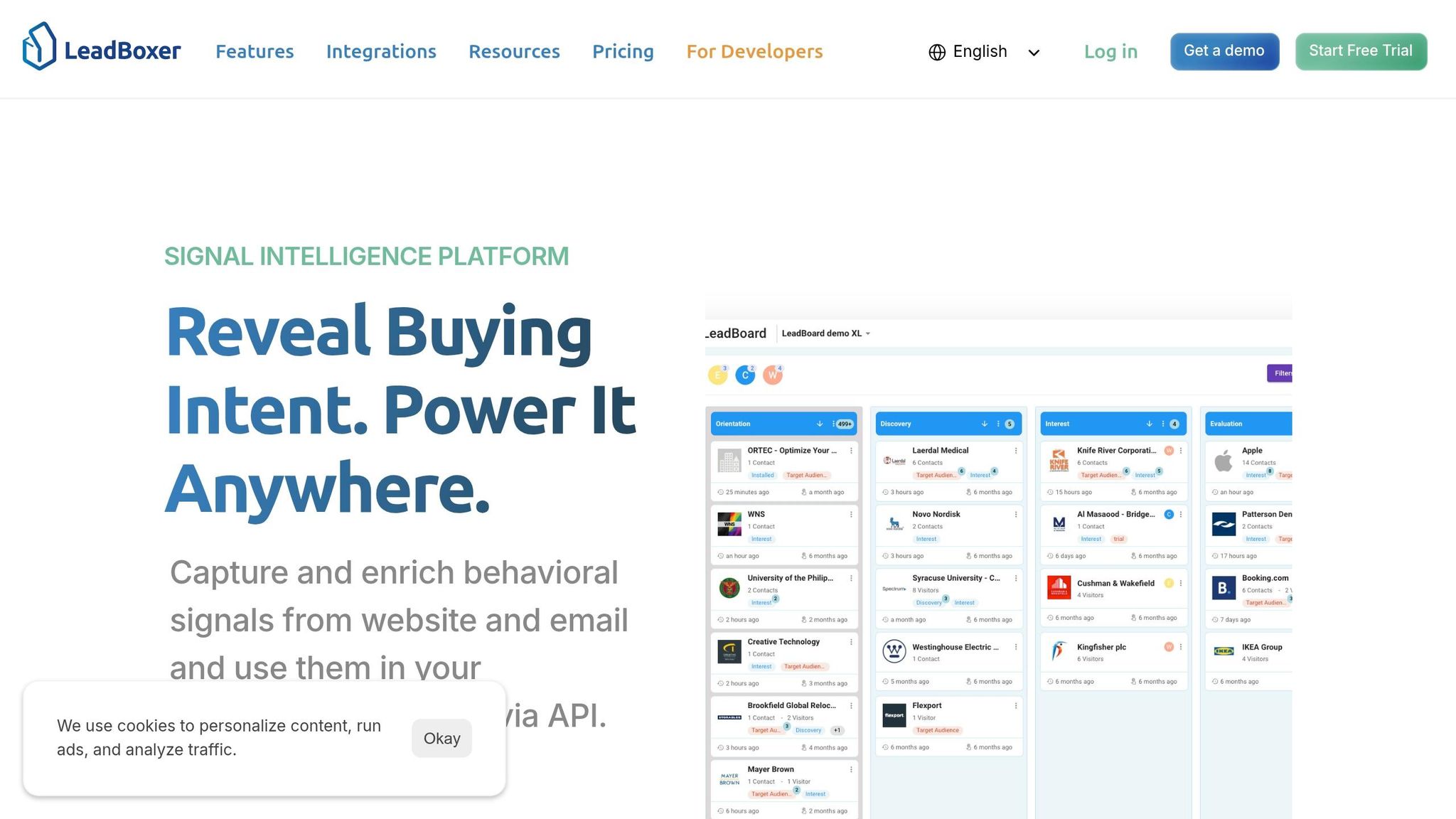
LeadBoxer Integration Steps
To get started with LeadBoxer, begin by signing up and retrieving your unique tracking code. Once you have it, paste the provided <script> tag into the <head> section of all key pages. These should include critical areas like landing pages, product tours, and pricing pages.
If you're working with a single-page application (SPA) like React or Vue, you’ll need to enable SPA mode. This involves initializing the script with specific API calls designed for virtual page views. After setup, you can verify the installation using the real-time dashboard - try checking it in incognito mode to ensure everything is working correctly.
Once tracking is active, you can take advantage of LeadBoxer’s /identify and /enrich APIs. These tools automatically map visitor IPs to company data and enhance profiles with firmographic details like industry, revenue, and employee count. For instance, here’s an example of how the /enrich API works:
For CRM integration, LeadBoxer offers native connections or the option to use Zapier. Depending on the CRM, you’ll configure OAuth for platforms like Salesforce or API keys for HubSpot. This setup allows you to map company and intent data seamlessly while enabling real-time or bidirectional synchronization. To optimize your workflow automation, consider filtering for high-intent leads - those with a score above 70. One SaaS company reported a 40% faster response time to leads by implementing this strategy.
By following these steps, you’ll be fully equipped to capture and analyze high-intent leads, turning anonymous visitors into actionable opportunities. This process relies on using intent data to prioritize the accounts most likely to convert.
LeadBoxer Pricing Plans and Scalability
Once you’ve integrated LeadBoxer, your usage will follow a clear and flexible pricing structure. The system operates on a credit-based model: 1 credit is used for each company lookup, while enrichments require 2–5 credits per action. If you exceed your plan’s credits, overages are billed at $0.02 per credit.
Here’s a breakdown of the available plans:
Plan | Monthly Price | Credits | Key Features | Ideal Use Case |
|---|---|---|---|---|
Free | $0 | 500 | Basic tracking, identification | Early-stage SaaS testing |
Starter | $99 | 5,000 | API access, enrichment | Small teams, fewer than 5k visitors |
Growth | $299 | 25,000 | Intent scoring, CRM sync | Mid-market, product-led growth |
Scale | Custom | 100,000+ | Custom integrations, dedicated support | Enterprise SaaS, high traffic |
For example, a SaaS company with 10,000 monthly visitors typically uses between 2,000 and 5,000 credits, making the Growth plan a good fit. LeadBoxer also provides alerts when you reach 80% of your credit limit. Higher-tier plans include auto-scaling options and volume discounts, with the Scale plan reducing costs to $0.01 per credit. Many SaaS companies have reported achieving a 3x return on investment within six months of using LeadBoxer.
8 Best Lead Generation Tactics for Software/SaaS companies
Best Practices for Maximizing ROI with Built-in Lead Intelligence
To get the most out of integrated lead intelligence features, consider these strategies to boost your ROI.
Building Dynamic Segments for Personalization
Tailor your engagement by segmenting visitors based on their behavior. For example, if someone requests a demo, that action should immediately notify sales. Meanwhile, a visitor downloading a whitepaper might be better suited for a nurture sequence.
Gated content can be a goldmine for identifying interest. When someone exchanges their contact details for a report or template, they’re signaling genuine curiosity. Pair this with behavioral scoring to refine your segments. A lead who repeatedly visits your product page and opens emails at a 70%+ rate shows much stronger intent than one who leaves after a single visit.
Behavioral Signal | Points | Impact |
|---|---|---|
Product page visits | 10–15 points | High intent indicator |
Whitepaper downloads | 8 points | Medium-term nurturing |
Demo requests | 25–30 points | Immediate sales readiness |
Email opens (70%+ rate) | 15 points | Strong buying intent |
Keep your lead scores up to date. For instance, when a score surpasses 80, route the lead directly to sales through Slack or email. Leads scoring between 40 and 69 should automatically join nurture tracks tailored to their behavior.
Once your segments are set, align your workflows to take full advantage of these insights.
Streamlining Workflows and Reducing Tool Dependencies
Many early-stage RevOps teams juggle over a dozen tools in their go-to-market (GTM) stack. This "GTM Bloat" often leads to overlapping functions, multiple scoring systems, and disconnected tools, driving up costs unnecessarily.
"The 2025 playbook is not adding more tools. It is consolidating around execution."
Jay Purohit, NurtureV
Start by auditing your tool stack for redundancies. If you’re using multiple enrichment tools, consolidate around the one that best aligns with your ideal customer profile. Built-in lead intelligence can replace separate tracking, enrichment, and scoring tools by integrating these functions into a single system - cutting your cost-per-qualified-lead by 40% to 60%. Simplifying your tech stack also enhances the effectiveness of dynamic segmentation and real-time analytics.
Set up triggers to automatically route high-scoring leads (above 80) to the correct sales rep. Since B2B data accuracy declines over time, real-time enrichment at the moment of action is critical.
Measuring Success and Refining Strategies
Regular measurement is essential to validate and improve your lead scoring and segmentation efforts. Track conversion rates by tier to ensure your scoring model is working - high-scoring leads should convert at noticeably higher rates than low-scoring ones. Businesses with mature lead scoring systems report a 77% increase in lead generation ROI. Still, ongoing optimization is crucial.
Ensure sales teams respond to high-scoring leads within 30 minutes to maintain engagement. Teams leveraging real-time behavioral data close deals 3.2 times more often, and real-time lead scoring can shorten sales cycles by 28%.
"Lead scoring fails when it's a number on a record instead of an operating system for follow-up, routing, and accountability."
Ameya Deshmukh, EverWorker
Hold monthly meetings with Sales, Marketing, and RevOps to review tier conversion rates and adjust point values based on recent closed-won deals. Use time decay to prevent outdated activity from skewing scores - reduce points by 50% after 60 days. Additionally, monitor for false positives (high scores that don’t convert) and false negatives (low scores that do) to fine-tune your scoring logic.
For SaaS businesses, track metrics like Monthly Recurring Revenue (MRR) and Customer Lifetime Value (LTV), aiming for a CAC-to-LTV ratio of 1:3. You can also apply the Rule of 40, where your combined growth rate and profit margin should hit or exceed 40% to ensure sustainable performance.
Conclusion
Built-in lead intelligence has become a game-changer for SaaS growth. By integrating tracking, enrichment, and scoring directly into your product, you can turn inactive signups into revenue opportunities while cutting through the inefficiencies that often slow down sales teams. The numbers back this up - Product Qualified Leads (PQLs) convert at nearly 5x the rate of traditional MQLs.
The urgency to implement this approach is clear. Instead of spending months building custom infrastructure, you can use a platform like LeadBoxer to integrate intelligence features in just days. As Lucas Correia, Founder of BizAI, highlights:
"Real time lead scoring AI isn't optional in 2026 - it's the revops edge crushing manual processes".
With B2B buyers increasingly favoring rep-free experiences, relying on guesswork in your funnel is no longer an option.
LeadBoxer’s API-first architecture offers a free tier with 25,000 credits, allowing you to scale as your traffic grows. This means you get real-time visitor tracking, company identification, automated intent scoring, and customizable workflows - all without disrupting your core development roadmap. Whether you’re a startup or scaling to handle thousands of daily sessions, the platform grows with you seamlessly.
Stop wasting time on unqualified leads. With embedded intelligence, you can identify high-intent leads in under 5 seconds, route them automatically, and equip your sales reps with the insights they need to close deals faster.
Want to turn anonymous traffic into revenue? Embedding lead intelligence into your SaaS ensures you make the most of every visitor, aligning perfectly with the strategies outlined above. Get started with LeadBoxer’s free tier today - boost conversion rates, shorten sales cycles, and drive revenue growth without increasing your team size.
FAQs
How does lead intelligence identify anonymous visitors without form fills?
Lead intelligence works by uncovering the identity of anonymous website visitors through a combination of network metadata, behavioral analysis, IP address tracking, and AI-enhanced data processing. Advanced methods like cookieless identification and identity graphs are used to connect visitor actions with company details. This approach allows businesses to gain actionable insights about their audience - without relying on traditional form submissions.
What intent signals should count most for scoring in my SaaS?
When it comes to scoring in SaaS, behavioral data plays a key role. This includes metrics like website visits, content downloads, email interactions, and how users engage with your tools. On top of that, micro-behaviors - such as how recently and how often someone takes an action - can reveal high-value prospects and active buyers in real time. These insights are invaluable for prioritizing leads and refining your engagement strategies.
How do I roll out lead intelligence without hurting site performance or privacy compliance?
To implement lead intelligence effectively while keeping your site running smoothly and staying compliant with privacy standards, it's crucial to use secure and efficient tools like server-side events and API integrations. These methods help reduce the load on the client side while safeguarding sensitive data.
Key strategies include prioritizing real-time data processing, leveraging automated lead scoring systems, and incorporating opt-in mechanisms to meet privacy requirements. Additionally, make it a habit to regularly validate event streams to avoid bottlenecks and ensure your data remains accurate and reliable.
Related Blog Posts
Build on the LeadBoxer Platform
APIs for tracking, company identification, enrichment and scoring. The first 25,000 credits are free.